
Unknown's avatar

Thoughts About Leading for Learning…Schools on the firing line

The current political climate has placed public schools increasingly in the news and not in a good way. In the last few years we’ve seen a rise in the use of terms like “failing public/government schools”, “failure factories”, “the tenure problem”, etc. Research conducted by Jane Mayer for her book, Dark Money, seems to indicate that this has not been accidental or coincidental. Rather it seems to have been an intentional plan to “normalize” the notion that our public schools have failed. Regardless of the intent behind the use of such terms and increasing calls for more choice options for parents, it is clear that these are troubling times for our system of public education and those who have committed their professional lives to working in it.

Moving Beyond “Other-directed” responses

Responses to this increasing criticism have largely been “other-directed”. This “assault” is part of an ideological agenda being pursued by wealthy philanthropists and business people who seek either smaller government, greater opportunities for access to educational dollars, or some combination of both. Or we have been handicapped in our improvement efforts by the imposition of a 30 year commitment to a test and punish accountability solution that has been demonstrated to be both bankrupt and ineffective. Or an explanation that connects student achievement and achievement gaps to expectations for schools to resolve decades long social issue that we have been unable or unwilling to confront. I know that these are on my list of “other-directed” explanations and they all have at least one thing in common… they distract us from the issues that we can control.

Katie Martin’s recent blog, “The Evolving Role of the Teacher”, offers an important break from “other-directedness” and addresses one of the areas we can control and can change.  She looks at the dissonance between the new knowledge we have about learning and the way this is experienced in many of our classrooms and schools. She offers a couple of examples’ one, which for obvious reasons, she doesn’t choose to identify and another, for equally obvious reasons she recognizes. Take a look…

A Tale of Two Classrooms

In this first classroom, the teacher is calling on her 5th graders, one by one to identify each of state and their geographic location. I talked to one of the students who told me they were learning the states because “the teacher thought it was important to know them” and when I asked if she knew a better way to learn about the states, she pointed to the iPad face down on her desk and said, “the Internet?” As I looked around the room, each of the students had their own iPad that was face down on the desk as they were copying the states from an Atlas into her map packet.

…this lesson, or some version of this lesson, is still happening in many “21st century” classrooms with an emphasis over compliance and standardization rather than deep personal learning. This example illustrates the challenge that exists in many classrooms when we add on new resources and expectations to an old paradigm of school.

Katie goes on to describe a different kind of classroom model. In Ms. Kim’s classroom

…a group of 4th grade students are engaged in a project where they are partnering with local business to understand their challenges and design solutions to impact their local community. In this classroom, groups of students are planning a pitch they are about present to the local water board. At the same time another group is designing a website for their business. Other groups are virtually collaborating with their organization to receive feedback on their product and building prototypes. The technology in this class allows all students access to relevant resources and to connect with people to learn, create, share and solve problems…

How do such variances in classroom/teacher practice vary so much? Ms. Martin provides a clear (and in my experience) accurate summation of where we are in our schools, noting that “Most educators in our schools and district offices have gone through their own education without the access and opportunities that exist today.“

Her analysis coincides closely with that offered by Dr. Phillip Schlechty in his book, Leading for Learning: How to Transform Schools into Learning Organization, published in 2011. Take a look at both Schlechty’s and Martin’s take on the necessary response.

Schlechty’s thoughts…

As a result [of new technologies] students are empowered to take on a more active role in the classroom, which becomes a shared space where teachers and students learn together and from each other. These newer technologies also give students a voice, where traditionally they had none, and provide an authentic audience of potentially millions.

Increasingly, students will direct their own learning and learning will happen in conversations, as opposed to structured lesson plans. And just as in life, learning will be connected rather than happening in isolation. All of this forces us to rethink how we do school.

So much of learning can and does happen outside the four walls of the classroom and with so many more people than the teacher. Learning doesn’t just happen between the hours of eight and three. It’s a continuous process for both teachers and students. We can no longer artificially filter what students are exposed to and instead have to help them learn to filter on their own. The lines between teacher and learner have to be blurred and the very idea of what is considered content has to be reconsidered.

Schlechty continues with a picture of what will occur if the transformation that he encourages does not take place…

And without transformation, about all that can be expected from school applications of new developments in the IT world is the digitization of past practices. More important is the fact that without the needed transformation, schools will play a less and less vital role in what the young learn and will be less and less important in shaping the worldviews the young develop. In the future, students will have increasing choice concerning the form their instruction will take and considerable control of the time and place that instruction will occur.

Remember, Phil Schlechty wrote these words in 2011. He wasn’t some guy peddling ideas on a street corner. Phillip C. Schlechty, who died last year, was an education researcher, speaker, and school-improvement advocate. He taught at both the K-12 and postsecondary levels, and served as a special assistant to the superintendent of Charlotte-Mecklenburg’s public schools. He also served in faculty positions and as an associate education dean at the University of North Carolina at Chapel Hill. Dr. Schlechty was the founder and CEO of the nonprofit Schlechty Center for Leadership in School Reform in Louisville, KY., an early initiative to create networks of school districts to experiment with and share best practices in leadership and student engagement.

It might seem that Phil wasn’t much of a futurist. Reading further, though, we see that he painted a picture of a future that seems pretty familiar and his words speak to us today. They add another dimension to our explorations.

With the advantage of an additional 5+ years of development to inform her sense of our needs, it’s interesting that Martin’s sense of the need, although adding some additional detail, does not differ substantially from Schlechty’s.

Martin’s thinking…

To meet the needs of the learners in our classrooms today and align school with the world we live in, there is a need to embrace new mindsets about learning, along with new tools and resources available to make these shifts across diverse classrooms.

She also echoes Schlechty when she notes that if we want our schools remain central in the educational lives of our young people our teacher must move beyond their learned roles of presenter of information, arbiter of what should be taught and when, assessor-in-chief – i.e., we must facilitate a shift in mindsets that both Martin and Schlechty advocate. So what are the ‘new mindsets’ that Katie is looking for?

Martin adds to Schlechty’s identification of needs that not only move the role of teacher from traditional teaching activities to a focus on the design of engaging learning experiences. Schlechty hints at and Martin expands that even this seemingly huge leap in role definition is not enough. She moves us beyond what we should not be to what she identifies as the new roles that we must embrace and enhance.

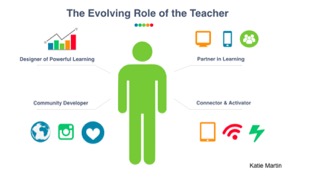
Her graphic portrays the roles that she sees as critical in the transformation process.
screen-shot-2017-03-01-at-11-52-44-am

Returning to her “Tale of Two Classrooms”, she uses her experiences in Ms. Kim’s room to add detail to each of the four roles she suggests.

Designers of Powerful Learning

The learning experiences described didn’t come from a curriculum guide. The experience was “co-constructed” with Ms. Kim’s students to achieve the desired goals. In both classrooms, students had technology – i.e., devices. However, they used them quite differently. Ms. Martin emphasizes that while technology can be a powerful tool, it “… no substitute for a teacher who designs authentic, and relevant learning experiences based on the unique contexts, strengths and interests.

Partners in Learning

 Ms. Kim and her students were learning together as they were collaborating with the businesses. She continues…

 When teachers embrace their role as a learner, everyone benefits. With so much information at our fingertips and new content and tools being created each day, it is impossible for anyone to know everything. Teachers and students as partners in learning models lifelong learning and empowers students to explore their passions and interests, rather than solely consume information.

Community Developers

Ms. Martin notes the importance of relationships and the teacher’s role in building such relationships. She adds to this that “the teacher’s role is pivotal in creating the community where students develop relationships with one another.” While the first classroom she described was compliance-based, Ms. Kim created community guidelines and established classroom meetings that “empowered learners to work together, seek to understand diverse perspectives, solve problems and communicate effectively” all of which are skills that are being identified within increasing emphasis by employers and higher ed institutions and which must be modeled and practiced in our classrooms.

Connector and Activator

Martin points out that Ms. Kim “designed opportunities for students to connect with one another…” but also with “with information and ideas beyond what she knew or could provide. She set up opportunities to connect with local businesses and provided the framework that empowered for students to solve relevant problems.”

Supporting the Evolving Role of Teachers

The actions and the implications for leadership…

The question for us as school leaders and as teachers was framed eloquently by Schlechty. His words are a challenge to us to assume control over the future of our schools/our classrooms, to treat learning and students as if minds matter more than the preservation of schooling as we have experienced it.

The questions are whether schools have the kinds of leaders needed to bring about such a fundamental transformation in the authority relationship between students and teachers, and whether the boundaries of the schools can be made sufficiently permeable to safely admit the information that the digital world makes available. Without such leaders, the transformation of rules, roles, and relationships that is required will not occur.

Martin adds to and balances Schlechty’s challenge to school leaders with “on the ground” observations.

…making these shifts across countless classrooms is more than equipping schools with technology or creating creative learning spaces.

To create powerful learning opportunities for diverse learners, teachers need to be supported to develop new competencies: skills, knowledge and dispositions to leverage resources and tools to support them in their evolving role. (Emphasis mine)

Critical points:

This is not about schools as “failure factories”.

This is not about teachers as self-serving, overpaid impediments to improvement.

This is about our willingness to move beyond “other-directed” explanations.

This is about the creation of cultures that embrace the new roles required to move our schools beyond organizations focused on teaching to the organizations we need – organizations focused on the process of learning, both for our children and for our adults.

This is about our willingness to move beyond the comfort of familiar zones of safety that we find in traditional roles of teaching and to explore the implications of engaging in the adoption of new roles.

Which of Martin’s new roles offers the greatest challenge for you?

Unknown's avatar

I’m sorry. I lied…

screen-shot-2016-10-29-at-4-08-56-pm

Pogo the Possum’s quote for Earth Day, April 1970 – Walt Kelly

I shared in my last post that this post would be dedicated to looking at the process of leadership, followership, self –reflection and the first steps to beginning a leadership self-assessment. I lied. At the time I didn’t know I would be lying but…


I find the times unsettling.

I suspect it is fair to conclude that most of us have found the election and post-election activities exciting… exciting in the sense that they generate emotion. Whether these emotions are hope or fear based, it is hard to escape the reality that we may be in for a time of significant change.

I thought I wanted to write about it. I started a piece which quickly became three pieces. I couldn’t make sense of them. I certainly couldn’t expect you to. I looked for connections. Connections were elusive. I watched the president’s farewell address. I was inspired. I was moved to tears. I watched the president-elect’s news conference. I felt like sticking needles in my eye. Wouldn’t it be ironic if the person who inspired me is remembered for ineffectiveness and the person whose thoughts scare me turns out to be effective.

What I want to write is challenging. It’s challenging because it’s critical of the culture of the system in which that I’ve spent almost my entire professional my life. It may be perceived as insulting. I don’t want it to be.

There are lots of things I don’t know about. I don’t know much about international trade deals. I don’t know much about national security. Or quantum physics for that matter. I know less about building walls. But I do know about education. I know this from angles that most folks haven’t had the chance to enjoy.   And here’s what’s challenging. I know that we, as educators, have earned much of the criticism that we are receiving and which threatens now to upend our world.

borowitz-img_0291No, it’s not all our fault. We’ve had the real life version of “A Confederacy of Dunces” telling us what was wrong and what to do and how to do it. Whoever thought that the National Governors’ Association would be a good group to determine what should be learned in our schools? Why would anyone think that a group who could come up with names like No Child Left Behind or Race to the Top or, as a sign of decreasing creativity, Every Student Succeeds could actually develop policies that made sense. No, it’s not all our fault.


But we’re complicit, far too complicit.

It’s why I pulled up the Pogo cartoon. Not because we are greedy, lazy, selfish, fat and happy as too many so-called “reformers” assert. I chose the cartoon to ease into the possibility that we may have spent so much time preserving the comfort, the familiarity, the efficiency of schooling that we have failed to respond to reality that schools designed to meet the needs of the 19th and 20th centuries are not suited to meet the demands of this time.

In an earlier post, I referenced a recent Gallup poll which revealed that student engagement levels in our schools drops from near 80% in early elementary grades to around 40% by a student’s senior year. I noted at that time, that if Walmart or Amazon experienced a similar drop in customer satisfaction, their response would not be to continue business as usual.

This morning I had the chance to read the latest post by a young teacher, Jay Armstrong. He writes on a variety of topics and I highly recommend his work. In this piece, he describes an encounter he had with a young graduate who dropped by to see him during the winter break from the college he was attending.   He describes a young man (“M”) who was considered an excellent student in an excellent school system. He was not doing as well in college and he was confused. He asked Jay…

“So what’s the point of school? Because I always thought it was to get good grades. Follow directions. Get a diploma. A means to an end, you know. That’s what my dad always says. But after twelve and a half years of schooling I’m really confused.  I mean really, what’s the point of school?”…

Jay continues…

“See, M was a “good student”. He was respectful, compliant, met deadlines and studied all his notes. And the system rewarded him for with a diploma for his obedience.

Unfortunately, the system never challenged him how to think on his own, to problem solve beyond rudimentary worksheets or to provide himself the audacity to question.

M was lead to believe that a grade of an A meant perfection. It meant there was nothing else to learn.

M admitted he was scared to death to be wrong, to make a mistake. For years he equated his self-worth with his grades. He believed success in school meant success in life.”

I don’t believe that this is an isolated experience. On the contrary, I believe that M’s experience is typical for far too many of our children. The calls for change that we are seeing now and the proposed solutions range from ill-informed to downright stupid. But “M’s” question gets to the heart of the matter. What IS the point of school? This is a question worth asking and it is increasingly apparent that it is one that we, as educators, better answer. For those of us who have devoted substantial portions of our lives to a career in education, the prospect of change and growing acceptance of the need for change is daunting.

We have not responded well to change. Not because we are educators but because we are human. When confronted with change, change which might disrupt the sense of safety and security we have managed to create in our schools, in our classrooms, in our minds, we have too frequently exclaimed “we can’t” when we mean “we won’t”. With the best of intentions we have tried to preserve schooling as we experienced it. We have ignored that ‘schooling as we know it’ has worked best for people like ourselves and far less well for those who aren’t.

As this piece has evolved, I realize that I didn’t really lie. This is precisely about leadership and the need for us to exert the kind of leadership that answers M’s question. To build the followership among colleagues and our communities that will be necessary to reveal sloppy thinking as sloppy thinking, to highlight that trying to do the wrong things right serves neither parents nor students, nor our profession well. This can’t be a time for fixed mindsets.

NOTE: I began to develop this piece after reading an extensive report which detailed the shortcomings of the “free market” approach to school improvement.  I had in mind providing readers with the kind of background that might be helpful in any discussions that might occur as the move to vouchers, choice, and privatization heat up. As you have probably noted, the piece went in a different direction.

Embedded in the report, however, was the story of a man I met quite some time ago and who was instrumental in the development of the voucher system implemented in Milwaukee in the 1990’s. Dr. Fuller, a noted civil rights activist, invested his life in trying to find better opportunities for poor, minority families and their children. As superintendent of schools in Milwaukee and frustrated with his failure to gain community support for his efforts to improve the experiences available to poor, black children, he became the architect Milwaukee’s voucher program.  Last night when I heard John Lewis speak with such deep conviction and quiet dignity, I was reminded of the struggles and courage of Dr. Fuller. In my mind, he picked the wrong solution but I felt it important to highlight the world of difference between the motivation of Howard Fuller and ideologues like Betsy DeVos. I hope you read the report.


Unknown's avatar

Why Change Doesn’t Change Much…Leadership in the post-election time


Recommendation: With an occasional exception, the focus of my writing continues to be centered on ways to improve learning and the processes involved in facilitating that focus. It’s where I’ve spent the majority of my career. My focus is not intended to minimize the importance of political action and ways in which political action may support or impede the improvement of learning. As I have in the past, I urge you to follow the writing of Jan Resseger for the policy side of educational issues. She is an ardent supporter of public education and a wealth of information and resources for folks seeking to become informed about education in the post-election time. Thank you.

Why Change Doesn’t Change Much…Leadership in the post-election time

middle of nowhere_1129

From the The Farside Gallery 4, Gary Larson


During the holiday break, I found myself returning repeatedly to the implications of the president-elect’s proposed nominee as Secretary of Education. I’ve found myself swinging between the exciting possibilities for change and the desire to ask my doctor for some strong anti-depressants.

Regardless of which end of the spectrum I found myself, I realized that the word which was dominating my thoughts was “change”. I also realized that, in spite of all of the changes we have seen in the quest for educational improvement, school reform, elimination of achievement gaps, etc., we have seen very little change in the way we educate our children. Oh sure, we’ve seen significantly different areas of focus: behavioral objectives, values clarification, content standards, large-scale state assessments, etc. We’ve also seen our share of “band wagons” and also our share of “train wrecks”. But with a few notable exceptions, all this change hasn’t changed much.

Why is that?

Spoiler alert… I’ve written elsewhere about the increasing awareness that the majority of change efforts that we have witnessed have been examples of trying to do the wrong thing (schooling) better at the expense of doing the right thing – focusing on learning. But there are many factors which are at play in making change result in actual change/transformation. In this piece, I’ll focus on one of these factors – an exploration of a critical connection – the connection between successful change, leadership, and adult engagement. In the second piece in this series, I’ll focus on intentional actions that can increase the probability of positive impact.

So here goes…

For past the 10 years, most of my consulting work has revolved around leadership and leadership coaching. I’ve learned some things and I’ve unlearned others. Here’s what I’ve learned. Many might characterize these as beliefs and I suppose, in some ways, they are; however, I sense that they are more than that because I have seen this work.

People rarely quit jobs. They quit bosses. This “quitting” may be in the form of actual departure, but in many cases, it’s a kind of virtual departure… they just “checked out”. (BTW, one can extend this ‘quitting notion to kids, teachers and content – i.e., kids quit teachers far more frequently than they quit content).

People stay in a job, engage (and stay engaged) when there is a clear sense of purpose (one that they can buy into), when they are trusted to have some autonomy, and when they feel that they are growing (getting better) in their work. See Dan Pink, Drive

Where does this engagement, this sense of purpose, this autonomy, this sense of growth come from?

Leadership. Plain and simple, leadership.

There is a direct and causal relationship between and among 4 factors that enable successful leadership:. Beginning with the end in mind, I’ll begin with followership.

FollowershipLeadership can be defined as the capacity to build followership. This assertion comes from a conversation with Tom Sergiovanniwho for years was the leading author of texts used in courses for supervision and leadership. See Moral Leadership: Getting To the Heart of School Improvement. In a presentation I had helped organize, Dr. Sergiovanni noted leadership is based on stewardship and service, not authority, rules or personality…that if you looked behind you and didn’t see anyone following, you weren’t leading.

So how is followership built?

People follow those whom they trust and who make them feel safe.

It is this belief that Simon Sinek, refers to as the Circle of Safety in his TED Talk, “Why good leaders make you feel safe”.

And how is this “circle of safety” and sense of trust built?

It is built through relationships. We have seen this over and over again in classes where students go the extra mile because of the relationship that exists between them and the teacher. We have felt it when, as adults, we extend and even inconvenience ourselves for people who care about us.

And how are these relationships grown and nurtured?

Susan Scott in her work on communication (see Fierce Conversations and Fierce Leadership) shares that such relationships are built or destroyed one conversation at a time. They are destroyed though impersonal, perfunctory, or insincere exchanges. They are built through deep, caring, honest conversations. These are not conversations held via email, they don’t take place in large groups. They occur face-to-face and are sometimes, as Scott describes them, “care-frontational”.

Relationships that come from such conversations foster trust and a sense of safety for risk taking. Such relationships foster in us the confidence that we are not alone and that we will not be asked to do what our leaders/ colleagues would not do themselves.

And so people confer leadership to those who have fostered these building blocks. These factors build upon one another and enhance the development and articulation of a clear sense or purpose/vision which can be shared and understood. When present, these conversations, the development of caring, supportive relationships, and the sense of trust that results from these build the kind of followership that allows the realization of that vision/purpose.

When these conversations, relationships, and trust are absent or only superficially developed, change initiatives, regardless of the nobility of their intent, falter. Want to test this? Recall an initiative that was considered high profile only a few years ago that has been replaced by another such “miracle cure”. I’ve worked in districts where we could have filled wall with post-it notes, each representing a program or new initiative that is no longer in use.

Question: Why did these fail? Why did little or nothing change (other than an unintended increase in willingness to be a part of the next great idea)?

Answer: Lack of followership!

Now look at the intentionality of the efforts. How clear was the purpose? How was it communicated? Who was involved? How frequent and honest were the conversations about the implementation? Who nurtured the relationships? Who made it clearly safe to risk and possibly fail? What was the level of followership that developed?

Here’s what happened to me as I was writing this piece. I found myself reflecting upon my time as an aspiring leader, as a titled leader, and, occasionally, as a good leader. I found myself not liking all that I saw in my reflection. I found things that I would love to go back and undo. I found times when I was blissfully unaware of my role as relationship builder or as role model for meaningful conversations. I recalled times when I saw no one behind me and blamed them.

My reflection didn’t grant me any “do overs” but it did push me to offer such an opportunity to you. And it’s a lead-in to the next post…how to conduct a self-assessment and how can we be intentional about maximizing the interaction of the factors I’ve shared as critical to the development of followership.

In researching some of the resources included here, I recalled a conversation I had one time with Dr. Tom Sergiovanni.  By the time I met him, he had enjoyed a long and successful career. In our conversation, Tom openly shared his disappointment with his earliest work. Leadership, he offered, was not about mastering the mechanics of supervision and management “Leadership, “ he said, “is about the capacity to build followership.”

Struck by this memory, I decided to revisit Tom Sergiovanni’s career and contributions. Dr. Sergiovanni died in 2012. Here’s an excerpt from his obituary contributed by a colleague who recalled the following quote from his friend…

“…the work of educators (should) involve not only their professional skills, but their hearts and souls as well in their commitment to the human integrity of the work of educating the young.” (Read more…)

As homework, I invite you to begin the reflection by responding to just two questions.

How is your heart and soul reflected in your leadership?

What are the challenges you face in bringing this to your work?

That’s the beginning of my next piece…

PS The keys to good leadership didn’t change with the election ♥

Unknown's avatar

Because it is You (Sic) Choice

Happy New Year! There is something very special about this holiday season. Whether you celebrate it in the context of a religious tradition or simply enjoy the sights, sounds, and family gatherings, I hope you have been able to find and share peace, joy and love during this time. My continued wishes are for health, curiosity and engagement for the New Year.

I’ve been thinking a lot about the terms intentionality, leadership and change and, in the next few posts, I’ll be sharing some thoughts about these,  why change doesn’t seem to change much, and how we can make change happen.

Coincidentally, as I was reflecting on this, I had the chance to have lunch with a long time friend and colleague during the break and, as expected, we spent considerable time talking about our experiences and what the recent election might mean for education. A few days later, Bernie shared the following memo he had sent to his staff when he was a principal and following the presidential election of 2000 which, prior to the recent election, was only the fourth in U.S. history in which the winner failed to win the popular vote.

Because it is You (Sic) Choice

As we enter the DeVos Times, I offer the following essay written as a high school principal for my parent newsletter 16 years ago on the occasion of the “electoral traumas” of the 2000 presidential election.

Bernard Josefsberg

A recent report included among the evidence justifying New York State’s recent school finance court decision the decrepit conditions in P.S. 187 in New York City’s Washington Heights This reference held more than academic interest for me: my own schooling began in P.S. 187, and I still have clear memories of my four years there. Standing under Charles Wilson Peale’s dour portrait of George Washington, I learned the Pledge of Allegiance. In those days, establishing and promoting that allegiance was an unabashed purpose of our public schools.

Many aspects of the current educational and political scene would make it difficult for Dour George to lighten up. In much the same way as P.S. 187 has fallen into disrepair, weeds have crept into our civic space. We seem to educate less for democracy and more for money. As a result, our democracy elicits less intelligent passion from us than it requires while our economic anxieties absorb more of our attention than any other purpose for schooling.

In this vein, the filter of Election 2000 casts some interesting shadows on recently released data from the National Assessment of Educational Progress (NAEP). At issue are the persuasive writing abilities of American high school seniors, Class of 1998. One of the prompt topics used in this assessment required students to advocate a position, either for or against, on the efficacy of voting — i.e., does one person’s vote make a difference, and therefore should one bother to turn out on election day. Responses were rated for quality (as opposed to the position taken) on a six point scale ranging from “unsatisfactory” to “excellent.” Ratings between these two poles included: “insufficient response”; “uneven response”; “sufficient”; and “skillful.”

Four percent of the tested population turned in “unsatisfactory” responses on the order of, “If you want to vote go for it. Because it is you (sic) choice.” Three percent produced “excellent” prose as suggested by the following essay introduction: “Whether a single person’s vote makes a difference in an election is irrelevant. A democratic nation is one that recognizes an individual right to think and formulate an opinion, and voting is a manifestation of that right.”

Between the poles, the population arrayed itself as follows: Insufficient = 21 %; Uneven = 30%; Sufficient = 32%; Skillful = 10 %.

In other words, less than half the population responded coherently.

Perhaps I am drawing too easy a line between “if you want to vote go for it” and last November’s electoral traumas. However, a democratic society based wholly upon individual wants is in jeopardy unless those wants include what a democracy needs. Among those needs are the virtues of mind and character which our schools, alone among our public institutions, are charged with fostering. For this reason, we need to pay the price required to sustain them and keep them vibrant. Someone once described an ideal democracy as “an aristocracy of everyone.” If growing intellectual poverty – in addition to the material kind – widens the divide between the haves and the have nots, I fear we will lose not only the ideal but the reality of our democracy.

So why would I include this “guest blog” here? I see it as a lead in to the next post on leadership. It’s a call to action. It’s a reminder that if we are not intentional about how we will lead the direction of learning to help our kids learn how to know, learn how to do, and learn how to be, we will continue on a trajectory that further advances the privilege of the wealthiest among us at the expense of equity, opportunity and the democratic ideal to which Bernie refers.

Can’t happen you say? Humorist Dave Barry offers the following from his annual  Year in Review. In the article, he has been working his way through the months and is now up to November…

“Election Day approaches, a consensus forms among the experts in the media-political complex, based on a vast array of demographic and scientific polling data evaluated with sophisticated analytical tools. These experts, who have made lucrative careers out of going on TV and explaining America to Americans, overwhelmingly agree that Hillary Clinton will win, possibly in a landslide, and this could very well mean the end of the Republican Party. The Explainers are very sure of this, nodding in unison while smiling in bemusement at the pathetic delusions of the Trump people. Unfortunately, it turns out that a large sector of the American public has not been brought up to speed on all this expert analysis. And so it comes to pass that the unthinkable happens…”


Unknown's avatar

Can we “unlearn”schooling and learn how to “be there” for kids?


screen-shot-2016-12-17-at-2-16-47-pm

from project50dates.blpogspot.com

“You can’t ever keep your kids from getting hurt, but you can be there for them when it happens”

Steve Yurchak, ca 1974

Happy New Year!

That quote was shared with me in a conversation with a very wise man when I was saddened by something that had hurt one of my kids. In this age of standards, high stakes testing, increasing academic and social pressures, I wonder if we’ve lost the time, freedom and commitment to “be there” for the kids we teach.

I was planning on taking a writing break for the holidays when life suddenly intervened and put an idea in my head. The idea came in the form of an article shared with me by a good friend. The author, Ted Wachtel, wrote about his journey as both a student and later as a teacher. With one sentence, he had me…

“However, not until I read “Deschooling Society”  in 1971 did I realize that the institution of school itself is the obstacle to learning for many young people.”

My reflections on this brought me back to Clark Aldrich’s book, Unschooling Rules, in which he describes the three critical types of learning that our kids need today: learning how to learn, learning how to be, and learning how to do. (For more on Aldrich and his thinking, here is a link to a YouTube presentation by him).This was a private reflection, one that I’ve been hoping will lead me to language sufficiently powerful to move readers to consider the possibility that Wachtel raises, i.e., school may be the obstacle. School may be, as Russell Ackoff asserts, an example of trying to do the wrong thing better and better.

I’ve written about this conflict previously, but something in the piece struck a new chord with me.   I connected it to observations I’ve been making recently about my youngest grandchildren, all four of whom are under the age of ten with three of them less than 5.

Each time we have the kids over or have babysitting duty (which I’ve come to realize is actually babysitting “privilege”), I’m amazed at how they much they learn, how serious they are about learning, how much fun they have doing it, etc. I don’t want to romanticize this process. There are times when they are frustrated, impatient, downright unpleasant. But they are natural learners. They are driven by curiosity and the need to find explanations for the world they are experiencing.

And then school/schooling happens. We’ve all seen it. Our kids and grandkids come home and after their first week we notice that they are raising their hands to speak. The proudly announce that they were named “line leader” for recess. Out nine year old responds to the question, “what was the best part of school today?” with one word “Recess”?

The school that happens to/for our kids reflects the need to “educate” increasing numbers of children, to insure that important information is transmitted to all and to do this efficiently. The result… kids grouped by age, kids moving in age based cohorts, kids being exposed to information organized by discrete content areas, and kids being evaluated largely based on their ability to recall pre-identified facts, etc., etc., etc.

We aimed for excellence and focused delivery of information on the average. We guaranteed the perpetuation of the system with only minor and incremental modifications by staffing the schools largely with those who had “succeeded” in such a system.

Enter the kindergartners or pre-schoolers, full of curiosity, full of questions, experienced in independent inquiry and conclusion drawing. Too often we treat this as a lack of the discipline necessary for learning. It reflects a need to impose discipline so that we can provide learning in the way we have organized it… it is about efficiency. We assume that certain kinds of environments are conducive for learning and we set about to create these conditions.

Because we have organized by age and by a preferred group size (an efficiency issue) we need to provide the environment in which kids thus grouped might be able to “learn” what we have decided they need to know, in the framework that we have determined to be best, and at a pace which is based on average not uniqueness.

Ironically, we do so, too frequently, at the expense of the very things that now, in the 21st Century, we are hoping to see in our children, in our graduates. We recognize our failings, or perhaps more importantly, we “recognize” the failing of our students and blame them and their teachers.

And we try very hard not to accept the observation shared by Wachtel, “…the institution of school itself is the obstacle to learning for many young people.”  But what if he’s right? What kinds of things might we consider for the new year?

And so here are a few of the primary questions that I’m  hoping we can grapple with…

  • How can we transform the “obstacle of school” to the “center for learning”? How can we create “circles of safety”, places dominated by the commitment to personal relationships and support for all?
  • What would happen if, at the very earliest ages and thereafter, instead of training young children how to conform to the culture of school, we intentionally focused on the further development of their innate curiosity, their desire for learning, the need to seek and explore explanation for the way their world works?
  • What would happen if, instead of focusing our high profile reform efforts on high school programs, we helped our youngest children understand that it’s great to follow their curiosity and decide what they would like to learn and that we can help them do that in our schools?
  • What would happen if we built primary and elementary learning experiences for children around what we now know about learning and worked on the development of metacognitive and self-reflective dispositions to enhance their natural inclinations?
  • What would happen if we removed obstacles to us “being there” for our children by focusing less at how to score higher on tests of content increasingly removed from the life needs of our students?
  • What would school look like if we acknowledged that Dewey was right and focused on the creation of learning experiences that extend well beyond thee walls of the school?
  • Would school still be an obstacle? Would schooling and learning still be in conflict?

Please feel free to use the comment option to share some questions of your own and if you know an elementary educator who might like this, please pass it along and suggest that they subscribe.

Unknown's avatar

Coming to a state near you

.Disclaimer: This is not an anti-charter school piece. In my work in the NJ Department of Education and as a consultant for the International Center for Leadership In Education, I have seen both exemplary and horrible charter schools. In the Department of Education my division approved more than a few and closed several. This is about our need as educators to be able to discuss with parents, friends, and colleagues the ways in which new policies can advance or stifle learning opportunities for our children.

For a while now I’ve been following the work of Jan Resseger and have referred to her blog several times here. Jan is a tireless defender of the concept of free public education as the backbone of our democracy and the right of every child to have equitable access to high quality learning opportunities. She has written extensively on the charter school funding issues in her home state of Ohio and, most recently, on the impact of the expansion of privatized, for profit charters in Michigan.

Why should you care about this?

This heavily subsidized agenda is coming to your state, to your town. We’ve seen this movie before. We’ve lived through at least 3 decades of “school reform” driven by the belief that ever more rigorous standards and an increasing reliance on large-scale assessment would be the solution to unsatisfactory student achievement. After all, who would ever argue for lower standards (excuse me for stealing a thought from Ken Robinson)? But did any of us foresee that these reform efforts would develop into 3 decades of No Child Left Behind, the Race to the Top, and the Every Student Succeeds Act?

And here we are again faced with the next great idea… expansion of charter schools, expanded vouchers programs, and re-toolrd versions of school choice. After all, who would argue that all kids shouldn’t have access to a quality school? But this is not about the validity of an idea.  Like school reform, it’s about the implementation.  It’s about what this idea has that looked like in those states that have been at the forefront of the school choice, charter schools, vouchers, and the privatization movement?

I suspect that many of us have been following the unfolding story of the ways in which our government may be changed as a consequence of the election. One of the more troubling proposed appointments has been that for the position of Secretary of Education, Betsy DeVos.

I first encountered the DeVos family in Jane Mayer’s fascinating book, “Dark Money: The Hidden History of the Billionaires Behind the Rise of the Radical Right”. Mayer is an award winning investigative journalist and has been a staff writer for the New Yorker since 1995. In her book, she describes and documents the ways in which billionaire philanthropists have used their fortunes to advance (aided significantly by the Citizens United decision) their own radically conservative, and often self-serving, agendas. While DeVos has no experience that involves working in public schools, she has extensive experience in promoting the expansion of privatized, for-profit charter schools, vouchers, school choice, and the advance of her very conservative Christian beliefs in publicly funded schools. If you’d like additional background on Betsy DeVos, I recommend a recent New Yorker article by Mayer.


As I have written previously, I believe that this is a time when we, as educators, must become more actively involved in what the future of learning looks like for our children. Most of us can relate stories of having been called upon to explain and/or defend either our profession or the direction of schooling. I write this in the belief that we must become informed and be able to serve as sources of objective and accurate information for our parents, for our community members, and our colleagues. To this end, I urge you to read Jan’s two-part blog on the history and implications of the DeVos appointment. You can read the first piece here and the second piece here. Jan also includes links to a number of her previous pieces that provide fascinating detail about the underbelly of the for-profit charter school business.


I offer the comment section of this blog as a starting point for an exchange of questions and thoughts. I encourage you to take the time to begin a conversation with me, but more importantly, with your fellow educators.


Unknown's avatar

All I Want For Christmas Is…

chhristmas-list

I decided this year to make a list of the things that I would really like. Unfortunately, as soon as I thought about that and thought it might be fun to put them here, I realized that I probably also had to give some thought to how I might nudge them along. Why do I always do that?

I like being loved and cared about so I decided I wanted that to continue. I didn’t want to be greedy so I decided not to ask for more…

So I guess I’d better think about how I can be better at loving and caring.

I don’t much like living in such a wealthy country with so much poverty. I want that poverty to go away…

I need to ramp up sharing all that I have with those less fortunate and be better at giving back.

I want my family to know that I love them.

I need to spend at least as much time with them as I do thinking about and working on my professional stuff.

I want well-intentioned philanthropists to spend at least as much time thinking about the impact and consequences of their generosity as they do insuring publicity about their contributions.

I need to continue to support the small circle of writers who are voices in the wilderness trying to improve understanding of complex issues in a world that values 140 character explanations.

I want the words “school reform” to be stricken from the world’s vocabulary. Along with that I want the standards, assessment, accountability movement to go away.

I need to ramp up my commitment to exploiting opportunities for testimony and op ed writing aimed at exposing the problem of trying to do the wrong thing better.

I want to see schools become centers for learning, recognizing and facilitating learning that extends beyond the walls of the school and acknowledges that learning which is learner defined and learner driven is a critical part of education for our country.

I need to learn more about opportunities that exist for such learning and can be shared. I need to work more with parent groups to create awareness of existing, but untapped opportunities for their children.

I want people who see children, schools, education, etc. as profit centers and callously use the best intentions of parents for their own selfish advantage to simply go away.

I need to be more aggressive in my support for those whose courage and mission drives them to bring such reprehensible activity to light.

I want those in our country who have endured and continue to endure poverty, racism, government and community neglect, bigotry, and hopelessness to see evidence of a commitment to reduce their suffering.

I must be better at acting on my beliefs. I need to discuss with my family what we can do.

I want peace, joy, and love for all those people that I’ve encountered on my life’s journey, especially those who have shared their gifts and wisdom with me.

Thank you to all.  Merry Christmas and blessings in this holy season.

Rich

Unknown's avatar

PARCC is a symptom, not the problem.


– Fixing the problems of school accountability, property tax equity, fair distribution of resources, and charter school expansion may be necessary but is not sufficient.

NOTE:  This post is a reprint of a response submitted to an article NJ Spotlight.com

testing-joe-brown-stop-educating

Reprinted from Joe Browen

A recent article that appeared here reporting on the release of school-by-school PARCC results generated a number of comments. As usual, the responses represented a cross-section of perspectives, demonstrating that we continue to get drawn into discussions and debates about doing the wrong thing better.

We are focused on test scores and accept without question the fallacy that they have importance beyond the system that rewards and punishes those forced to use them. The results may serve to allow us to extol/defend the wisdom of our own views of racial equality or inferiority, of sufficient/insufficient moral fiber, of tax equity or burden, etc. but they tell us nothing about the impact of schooling that we didn’t know 30 years ago.

Since the publication of A Nation At Risk (1983) we have accepted the commitment to ever more rigorous standards and accompanying assessments. We’ve been doing this now for 30+ years. And the result? Flat NAEP scores, precipitous declines in student engagement, and persistent achievement gaps. And this year the Department of Education discovered that rich kids outperform poor kids and defined it as a civil rights issue. I suspect many of us could have provided that bit of wisdom without adding a penny to Pearson’s bottom line.

What the policy folks seem to be trying hard not to hear is that human resources departments, business leaders and employers, higher ed officials, etc. are saying that the areas of current instructional focus and assessment are NOT the things they need to see. We need (as defined by the consumers of the educational “product”) graduates who possess skills of cross-cultural tolerance, perseverance, ability to function as members of a team, resourcefulness, resilience, creativity, etc.

These are not tested and are rarely taught with the same level of intentionality as those things that are tested. We continue to teach and test the things that are most easily assessed, expending huge amounts of money to tell what have known for decades. Students perform on these tests by zip code.

But perhaps it is the comments offered in response to the article that provide us with insight. It’s apparent that we are living in a time when facts and truths are only valid if we choose to believe them.  We can choose to act on these facts or we can choose not to believe them. A few examples…

  • We know far more about learning than we did in the 1890’s when the basic structure of our schools was developed.
  • We know that kids no longer need schools to provide them with information that is now available 24/7 to the vast majority of our children. In the battle for the dissemination of information between teachers and Google, Google wins every time.
  • We know that kids do not learn at the same pace and in the same way… they persist in being different.
  • We know that “carrot and stick” approaches work better for lab rats than humans.
  • We know that the approaches based on standards and high stakes assessment lead to standardization, not the best performance in each kid.

We also know that schooling as it exists in our country is not meeting the needs of far too many customers and clients. But according to the “reformers” we don’t have a system problem. We have a teacher problem. We have a standards problem. We have an accountability problem.

Enough already. The structure of schooling that was designed in the 1890’s and worked for many of us in the 1900’s no longer works. It doesn’t work as well as it should for kids in the suburbs and it certainly doesn’t work for kids living in poverty. It is precisely these conclusions, facts, and truths that drove, and continues to drive, the school improvement/reform movement.

But here’s another, less convenient truth. Using the standards and assessment model to get closer to a good school for the 1980’s isn’t gong to cut it. Creating increasing the number of charters that, under the banner of incubators of innovation, more and more resemble the schools we remember with nostalgic fondness isn’t going to cut it. We decry the results of comparisons of academic performance between our country and other countries of the world. And while we want those results, we reject their systems as impossible to implement. We use the words “we can’t” and “we won’t” interchangeably.

Some of the most successful schools in the country are those designed to meet the needs of students who have not found success in the traditional structure. They involve learning in the community, strong internship/apprenticeship opportunities, highly relevant experiences, intentional levels of attention to the connection between relationships and motivation, days and years which do not follow structured bell schedules or calendars.   And, ironically, we name them alternate schools.

In this campaign season it seems excusable and appropriate to hijack the title of a book by former presidential candidate, Al Gore’s An Inconvenient Truth.

Could we consider the possibility that we are dealing with our own “Inconvenient Truth” – that the mission of providing each and every child with the kind of education that enables her/him to become a positively contributing member of our society and to have the chance to lead a full, safe, and satisfying life will not be contingent on who wins the argument over the relative moral fiber of the rich, the poor, the black, brown or white? Could we consider that it will not be based on who argues most forcefully for the equity of tax burdens? Could we consider that it will not be based on the quest for the perfect metric for accountability?

Finding new and more expensive ways to highlight performance that is disappointing is not a plan. Continuing to promote the improvement of schooling, with its focus on compliance, structure, and standardization is not a plan. We have demonstrated repeatedly that we do not do large scale problem solving and solution development well. See War on Drugs, War on Poverty, War on Terrorism, etc.

WWWD – (What Would Walmart Do?) If Walmart were faced with 30+ years of flat sales and 30% drop in customer satisfaction (the actual drop in student engagement between elementary and the end high school), do any of us think they’d double down and do more of what they had been doing?

So what should we do?

  • We can expect/demand that the state’s Department of Education and members of the state Board of Education accept the responsibility of leadership, reject ideologically driven initiatives, move beyond the command and control mentality, and own the meaningful exploration of options.
  • We can act in our communities to empower local boards of education to reject a continuation of mandated programs which have been ineffective at best, costly and harmful to children at worst.
  • We can expect school leaders to accept the responsibility to inform their communities and their boards of education about the evidence and options for change.
  • We can suggest that professional educator organizations end their participation in department of education work sessions designed to insure the implementation of increasingly mindless initiatives.

We can remember that not one of the children in our schools asked to be born, whether they are rich or poor, black, brown or white, in a traditional family or not. They should not be held hostage by our disagreements over moral fiber, life choices, tax burdens, and ideological differences.

The poem on one of our most revered and treasured landmarks reads…

Give me your tired, your poor,

Your huddled masses, yearning to breathe free,

The wretched refuse of your teeming shore,

Send these, the homeless, tempest tost to me,

I lift my lamp beside the golden door.

Author: Emma Lazarus, Statue Of Liberty

It doesn’t read, “…And I will blame them.”

Unknown's avatar

Why Is Change So Hard…


“We have met the enemy and he is us”

screen-shot-2016-10-29-at-4-08-56-pm

Pogo, the possum’s quote for earth Day = April 1970 – Walt Kelly 


I ended a recent piece with a quote from Bruce Dixon – “the biggest myth about school change is the possibility of change.”


At the time I mentioned that I’d be returning to that piece with some thoughts about the change process in schools and, specifically, why it’s so hard. I’ve been reflecting a lot on several ideas and experiences that I’m going to try to weave into some kind of sensible fabric here.

  • Susan Scott, in her book, Fierce Conversations, shares an explanation of the Pacific Islander term “mokita” – the things that everyone in an organization/group tacitly agrees not to discuss.
  •  Simon Sine’s TEDTalk on what makes people follow leaders and his description of the “circle of safety”
  • The notion that people don’t quit jobs as much as they quit bosses.
  • Piaget’s theory that children enter school with explanations for how the world works and the majority of these explanations are wrong, frequently requiring that unlearning must precede new learning.
  • The idea that leadership is actually the ability/capacity to build followership.
  • Followership is based on relationships and trust.

When Susan Scott introduces us to the concept of “mokitas”, she notes that often people in work, in families, in organizations tacitly agree never to discuss things in the name of group or organizational harmony… most frequently, at the cost of honesty and, all too frequently, at the cost of trusting relationships.

Quality relationships are not based on the shaky ground of mokitas. Add Simon Sinek’s work on what makes people follow leaders to this mix and you get the notion of organizational safety. Sinek offers that good leaders provide a “circle of safety” for the members of the organization, a safety built on trusting relationships. We rarely have strong and positive relationships with folks whom we cannot and do not trust.

Closely related to these two concepts is the notion that Piaget offers, and while developed around the learning of children, it can easily be applied to adults and adult learning.

During a normal career in teaching, most of us have experienced some times when we perceived that there was no “circle of safety”, where there were obvious of mokitas, too little trust and little risk taking.

We learned that there were some “truths” that no one talked about. One such truth was that it didn’t pay to get too invested in the latest change initiative because, like many others, it would soon be replaced by the next “new, better” thing.

We learned that most of our best relationships were with the people with whom we felt safe. People we learned to trust. People we deemed to be “trustworthy”.

We also learned that much of the leadership in the school/district was based more on compliance than the creation of followership.

And so we learned an explanation of how our organization worked. Sometimes our learning was accurate. Some times it was less so. But it made little difference. We had explanations about the way our world worked and we made decisions based on that reality… regardless of their accuracy.

In too many instances in school cultures, that reality told us that change is can be dangerous. Change can be painful. Change can be frustrating. Change can be hard work. Rarely did we see examples of change being good, with the exception of the occasional changes in ”leadership”… that is, until we learned that changing the person but not the culture was just a different kind of “not so good”. For many of us, it became our reality to distrust even the change in leadership.

And here’s the Pogo Mokita…

Most of us who have spent significant time as teachers can admit that every now and then we would have a class where “the chemistry just wasn’t right”. Things never quite came together. Teaching that group became like swimming through mud.

After experiencing that a couple of times, I came to recognize the part I played in that dynamic and it had to do with the lens through which I was seeing that group. I didn’t “own” who they were, but I certainly owned how I saw and responded to them. It wasn’t an easy “learning” for me. I was able to have that conversation with myself but I certainly wouldn’t have tried to extend the idea to my colleagues that we were responsible for how we saw and responded to kids in our class or the class as a whole. Circle of safety? Hardly.

For the chemistry to change I had to change my lens. It is the same with change. If we don’t begin to change the lens through which we see schooling and learning we prove Pogo’s point that we have met the enemy and he is us. We have not had an easy time changing lenses. As I traveled around the country visiting schools, I saw this pattern much too frequently.

Too frequently, we have allowed experiences to form explanations that cause us to reject change and that excuse our unwillingness to change. We’ve said “we can’t” when we really meant “we won’t”. We have focused on “other-directed” explanations. If only the state wouldn’t be so prescriptive, if only the board would give us more time, if only these kids were more like they used to be, etc., etc., etc. Feel free to fill in the blank here.

But here’s an “inconvenient truth”. We are working in a system in which the engagement of level of children drops from well over 70% in elementary school to barely more than 40% by the end of high school. We are working in a system that as designed and structured around the ideas and recommendations of the Committee of Ten in the 1890’s. At he same time we are systematically ignoring what we can find in research and what we intuitively know about the ways in which children learn best and, by doing so, we are yielding responsibility for “reform” to people poorly equipped to have such power.

We are not the architects of that system but we are the keepers and we are continuing to ‘keep’ the “wrong” system. We do this by bridling at the mention of a change in the school day structure, a change in the grading policies of our school, a transfer to a new grade level, a change in student grouping patterns or curriculum. We are promoting the development of a ‘growth mindset” in students while ignoring the consequences of adhering to our own “fixed mindset”.

Gandhi suggested, “Be the change you wish to see in the world.”

The possibilities for meaningful change in our schools, the potential unlocked by the creation of circles of safety, the potential of trust and honest conversations, rest in no small degree on our willingness to expose our mokitas and to create circles of safety where we can begin the process of unlearning and relearning.

The last thing I want on my gravestone is “Pogo was right.”


Unknown's avatar

Where’s the Apostrophe When You Need It?

One of my favorite authors is Susan Scott. She’s written about the importance and process of having productive difficult conversations. Her works include Fierce Conversations and Fierce Leadership. I’ve used them in my coaching work and they provide an excellent approach to doing something that too many of us have had to approach with little or no formal training.

screen-shot-2016-10-14-at-2-15-29-pm

Commons@wikimedia.org


In one of her talks she recounts a conversation she had with her young, school age daughter who returned home from school and announced that she had had an apostrophe in school that day. Scott was confused and asked her, “An apostrophe?” Her daughter continued, “Yes, Mom, an apostrophe. You know…a new idea.” Aha, thought Scott, “an epiphany”.

As many of you know, I have focused a lot of my recent learning on the differences between having students (and adults) learn how to do school as opposed to how to focus on doing learning. I’d like to call your attention to a piece I read recently that might add additional depth/insight to this.

A recent post by Bruce Dixon in Modern Learners brought Scott’s story back into focus for me. Dixon begins his piece by calling attention to the issue of bells in school. He quickly moves to a much larger question. The issue of bells

…leads to broader issues around the structure of the school day, the structure of learning groups, and how the physical learning environment best serves those outcomes.

All of which begs the question, why do we do what we currently do in our schools? Are we doing the right things by our students, or just doing the wrong things right, because that’s the way we’ve always done it?

The answer isn’t bells or no bells, 40, 50 or 100 minute lessons, or mixed aged or segregated classes. The answer is found in our beliefs about how our students learn, and under what conditions they will learn most powerfully and deeply.

Dixon continues and refers to work by  Seymour Papert (“Why School Reform Is Impossible”)  in which he suggests (and this is the ‘apostrophe’ that has yet to reach critical mass):

“The structure of School is so deeply rooted that one reacts to deviations from it as one would to a grammatically deviant utterance: Both feel wrong on a level deeper than one’s ability to formulate reasons.”

Dixon extends Papert’s conclusions by adding …

“So the biggest and fattest myth is that the learning needs of our young modern learners today are well served by the traditional model of schooling.“

And here lies the apostrophe/epiphany. It is the realization that schooling does not equal learning and, in too many instances, it doesn’t even lead to learning… other than the learning about how to ”do” school. Schooling as designed and refined in its current form emerged in the late 19th century is not sufficient for the needs of our current time. But not only is it not sufficient, there is growing evidence to support the conclusion that it is impeding the response to such needs.

Aided and abetted by the questionable motives of some “school reformers”, we are witnessing an unprecedented decline in confidence in our public schools (and by extension our teachers). We are seeing the “selling” of charter schools, expanded choice options, and a rise in the home and unschooling movements.

Even the recent high profile competition organized and led by the widow of Steve Jobs, the XQ Superschool Initiative, which offered awards of $10 million to successful designers, focused on the re-creation of school.

Apparently, wealth and good intentions do not equate to apostrophes and epiphanies.

In a recent presentation for approximately 150 teachers and administrators , I asked the participants how many had learned something within the past month by going to YouTube.  I saw a sea of hands. I then asked how many had done this either during school hours or from within the school building. Three hands!

The apostrophe. This is no longer 1890. It is no longer 1990. Schooling is not learning. Schools as models and, perhaps, centers of learning will and should continue. Schooling with its focus on efficiency, convenience, compliance and standardization should not and cannot.

Dixon concludes

“Perhaps the truly biggest myth about school change is about its possibility. So little has been changed by so few, that many still find it hard to believe it’s even possible. Maybe we should start by busting some of the myths that endorse our existing model of school and create some truths that better reflect the realities of learning in our modern world.”

Where would you start? What Myths would you start to explore?

And so, the next post reveals itself…why is change so hard? Exploring Dixon’s assertion ”the biggest myth about school change s the possibility of change”… why is that? What are the implications?