Unknown's avatar

I’ve seen your future and…

A long time ago, while attending graduate school, I witnessed an exchange between the professor and one of my classmates. After a particularly heated exchange in which it seemed that all members of the class got it with the exception of the lone, belligerent student, the professor said, with both a remarkable lack of charity and equally remarkable insight, “Son, I’ve seen your future. It doesn’t work.” I was reminded of that statement when I read Bernard Chan’s article, For the digital economy, traditional education needs an update.

As some of you may know I was very fortunate to be able to spend a few years working with a exceptionally talented group of people at the Successful Practices Network on the development of the SPN Career Readiness Institute. The primary focus of that work was an attempt to achieve greater balance with initiatives aimed at improving college and career readiness. At the time we began our work, there was a significant body of research emphasizing the importance of the intentional development of what were called “soft skills”. While there were various lists of such skills, there was surprising agreement on many– i.e., strong work ethic, team oriented, tolerant, organized, flexible, effective communicator, etc. – and there was a growing consensus about the importance of such skills and dispositions, In spite of this awareness, however, the commitment of policy makers to test and punish approaches as the way to raise student academic achievement dominated the majority of school improvement initiatives.

Today, more and more parents, educators and a growing number of business leaders are coming to “see the future” and are recognizing that “it doesn’t work”.

Some time ago I recall reading (it may have been something by Stephen Covey) about the problems that occur when we pay more attention to our “to do” lists than to the interrogation of our direction. If I recall correctly, he described this as a conflict between the tyranny of the calendar and a focus on the compass. I see now that this was another way of getting at the distinction between time spent trying to do things right versus spending time trying to do the right thing.

As I continue to explore the relationship between change and leadership and the ways in which leadership can be more effective in moving the beyond the self-perpetuation of the disproportionate emphasis on schooling and the ways in which this, too frequently, is at the expense of the needed focus on learning, I encountered a post by Bernard Chan.

Chan is the founder of ALPHA Camp, a tech school startup with campuses in Singapore and Taipei. He is from Hong Kong and has degrees from both MIT and the University of Waterloo (Canada). What makes his perspective potentially instructive is that he speaks from the perspective of one of the world’s most successful countries as measured by the standards and assessments that we have elevated to “godlike” status here in the US.

He introduces his thinking as follows:

I remember when I moved from Hong Kong to Canada in the 1990s, school got easier for me. I was getting 100s in some of the math and sciences classes — something unimaginable before. Asian countries are known for tougher but “better” school systems. In a global education survey, Singapore even topped the ranking for proficiency across all the key fields of reading, science, and maths.

However, in my capacity as the founder of a technology school in Asia, I have concerns that education systems across the region are resting on their laurels when it comes to preparing students for the new economy. In fact, I would argue the current pedagogy and [sic] is incentivising the students to become exactly the opposite of what “talents of the future” need to be. (Italics mine)

Chan echoes the work of many involved in finding a balance between academic achievement and the development of skills and dispositions that are critical to the preparation of learners for a rapidly changing world.

He offers examples of the paradigm shift that is underway and notes that because business problems are “more complex and dynamic” we see increasing examples of new companies “empowered by technology and innovation” working in ways that demonstrate that “there is no one right answer to a given problem”.

While we tend to focus our assessments on the ability of students to choose the “right” answer, there is increasing evidence to support the reality that “questions are becoming more important than answers” and that cross-disciplinary solutions are increasingly becoming the norm.

In completing the shifts that we are experiencing, Chan concludes

Hard skills are becoming vulnerable. Technology and artificial intelligence now allow many of the more process-based jobs to be partly or fully automated, including in highly professional industries (e.g. accounting, finance, law). Hard skills are becoming less relevant; instead, success will go to those who can effectively break down a problem into parts and find the right people/tools for each.

A word to those who recoiled at my use of the term “godlike” status in reference to our affection for a standards and assessment base approach. This is NOT about promoting the absence of high standards. Sir Ken Robinson may have captured the essence of this false argument when he stated (my paraphrase), “Of course we want high standards. Who in the world would ever argue for low standards?” This is NOT about standards. It is about the kind of standardization that has developed in response to the desire for rigorous standards.

Chan captures the essence of the issue when he notes (again from a perspective of a country that leads the world in test-based measures of academic learning) that the current pedagogy is incentivising the students to become exactly the opposite of what “talents of the future” need to be.

Here is where Chan’s work in Asia and our work here in the US is dramatically similar. The dissonance between learning targets and real-life needs: The mismatch of growing learner needs and traditional focus and strategies.

He cites that having trained more than 2,000 people across Asia he has seen the ways in which schooling has shaped the way students process problems. His descriptions are eerily similar to the critiques we have been seeing with increasing regularity about the results of our own system of schooling.

Consistent with the increasing criticism of the results of focusing on preparing students for success on large-scale assessments – i.e., the over-emphasis on learning and/or finding the single correct answer – students both here and in Chan’s Asia demonstrate difficulty in dealing with problems having multiple solutions.

Not only does the ‘teach to the test’ consequence of high stakes testing continue to place disproportionate emphasis on the acquisition of hard knowledge and shortchange both time and intentionality devoted to the development of soft skills/dispositions, it seems directly correlated to the focus on the ‘single correct answer’ and the dominance of ‘one way’ learning. Chan notes that, in his schools, he has seen diminished patience for figuring things out, minimization of the importance of finding things out and for the process of problem solving.

I am tempted now to channel my inner Rachel Maddow and try to build to a dramatic conclusion. Blessedly for those of you still with me here I’ll just add one more piece. This comes from a post I read this morning by Jordan Greenhall on Medium entitled, And Fear No Darkness. He is talking about the various ways one might interpret the current state of our political process and the implications for our future. He probably didn’t realize (or care) that he was speaking to me about the issues facing our schools and our system of public education. He is building on the word “crisis” and the implications of understanding how it might/might not apply to our political climate and the state of the world. When you read this next quote think “schooling”.

A crisis is a process of transformation where the old system can no longer be maintained.

This is the deep point and understanding it brings clarity. A crisis is a threshold between an old system and a new system. From the point of view of the old system, the crisis is death. This is why the old system always struggles like hell to stave off the crisis. I don’t want to be uncharitable here. Systems are hard to get right — so leaving an old system into some new, untried and untested system is almost always a truly terrible idea. And even if there is some new system to get to, the transition itself will be unavoidably painful and often fatal. The instinct to preserve the old system at all costs is almost always an adaptive instinct.

One might argue that Greenhall’s portrayal is extreme. But taken together, Chan and Greenhall speak to me of a sense of urgency. Chan tells me that if you don’t pay careful attention to the compass, you may not wind up where you thought you would be. It’s one thing to “double down” on current strategies with the goal of reaching the mountain top. It’s quite another thing to have done that and find out that you’ve been climbing the wrong mountain.

Greenhall says to us as educators that it is normal (and predictable) for systems in crisis to fight to the death to stay alive. Our system is on the edge of crisis. We began a journey in good faith and with great intentions… all kids should become college and career ready. Is this the wrong goal? I’d be hard pressed to argue that it is. But what I can argue is that equating college and career readiness with one form of measurement (a large scale standardized assessment) and with a focus on hard skills, which are rapidly disappearing and diminishing in importance and which are delivered in discrete content chunks and in standardization format, needs our attention. It’s the wrong mountain.

Coming Next – How to Climb the Right Mountain
Unknown's avatar

“We Got It From Here… Thank You 4 Your Service.”

When I started this blog, I did so with the intent of committing to add at least one piece each week. Whoops!

And here I sit this morning watching the snow fall here in scenic Little Egg Harbor. It’s just a day after I was taking my sometimes daily walk to the inlet thinking this might be the year I actually put the boat back in the water earlier. Talk about change. I guess I could get cranky about missing my walk (that I might not have taken).

Like many aspects of our lives, I’ve managed to turn my walk into a kind of multi-tasking exercise… I walk because it’s supposed to be good for me. I also walk to think. It’s kind of amazing to think of all of the posts you’ve not been subjected to as I discarded them while working my way along the salt marshes to the beach. I even added another component to my walking and to my thinking time… I pick up trash. No, not the remains of my discarded ideas, but real junk that other users of this road have seen fit to toss.

What a metaphor for life. Multi-tasking is now the norm. To not multi-task is to somehow feel guilty that we aren’t using our time wisely or productively. It’s a change in how we live our lives. Today’s snow after yesterday’s warmth is another reminder of change and a reminder that change is everywhere.

And so, as the universe would have it, this week I encountered an article by Sebastien Turbot in Forbes magazine, “Education: Change Is Here. But Are You Ready For It?”

Turbot is an interesting guy. He is currently the curator and director of the World Innovation Summit for Education (WISE) located in Qatar. He serves as an adjunct professor at the Paris School of International Affairs, is a Fellow at the Royal Academy for the encouragement of Arts, Manufactures, and Commerce and served as the editorial director for TEDx Paris.

He summarizes the dilemma facing educators today throughout the world as follows:

Our education system wasn’t much of a problem until now. The system addressed the 19th century industrial revolution needs for labour that could perform simple and repetitive tasks. But that era is long over. Our children must gear up for the ‘gig’ economy. By the time today’s graduates are 38, they would have gone through 10 to maybe 14 jobs. Moreover, 15 years from now, 65% of graduates will be going into jobs that don’t exist yet.

He describes a situation familiar to many of us. The changes that we are seeing, some of which have occurred as we continue in our practice, and others which politicians and policy wonks have defined for us, leave us wrestling with how we are to break away from our traditional approaches to teaching and learning.

So my first answer to Turbot’s question “Change is Here. But Are You Ready For It?” is easy. Of course not. The majority of us do not find change easy. Change threatens us. It threatens our sense of efficacy (maybe I won’t be able to learn this new stuff or be as effective as I am now). It threatens our confidence in our ability to adapt (what if I’m one of the “old dogs” who can’t learn “new tricks”?). It threatens our sense of order and comfort (I finally learned how to teach volcanoes successfully and now you want to take it out of the curriculum?). Turbot suggests that the changes we are being asked to accept and embrace may “…resemble the current state of our world: chaotic and ambiguous.”

But denying change or trying to ignore it is futile.. and increasingly stressful. I recently read the following quote and apologize in advance to the author for not remembering the source… “In trying to adapt to change, we have choices. We can crawl or we can run. But we can’t stand still.”

Why can’t we stand still? Why can’t we do school the way we’ve experienced it ourselves and the way we’ve passed it on to kids for the years we’ve been teaching? Or maybe a bit more subtly… But which changes am I supposed to respond to?   My school is a “change factory”. We barely understand one before the next one is thrown at us. I’ve visited numerous schools where we could have filled a wall with post-it notes each naming a new program or change that the school or district has “embraced”. Most of these have one thing in common. No one’s doing them any more!

We can’t stand still for the very reasons that Turbot shares when he offers the results of the WISE study on jobs of the future. Everything about our world today screams access. Access to information. Access to people. Access to learning. And none of these accesses scream school. I needed to wire a three way switch at home. Where did I go? You Tube. I’m learning to paint in water colors. From where? You Tube! My grandson is struggling with statistics. Where does he turn? Khan Academy.

Dr. Christopher Emdin, Associate Professor in the Department of Mathematics, Science and Technology at Teachers College, Columbia University titled his keynote address at the South By Southwest Education conference (SXSWEdu) “We Got It From Here… Thank You 4 Your Service.”

“We got it from here” is what kids all over the country are beginning to believe. Dr. Edmin points out that “thank you 4 your service” is just a polite way of saying “you’re fired”. Our value of educators is no longer the transmission of information. It is no longer organizing schools in pursuit of efficiency. It is not even in the organizing and sequencing of content in the courses we teach. If we persist in trying to do these roles better, we will hear with increasing frequency the words “We got it from here. Thank you 4 your service”.

One of the changes we have to learn how to embrace is how to teach our kids to develop a commitment to learning and how to help each kid (and each adult) in our school communities learn how to use the tools and access available to them in ways that help them develop the skills and dispositions necessary to succeed in jobs we cannot predict.

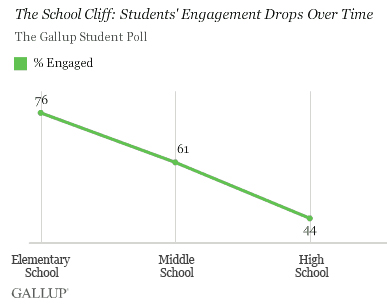
In the years I spent traveling the country and working with schools and districts, I had plenty of chances to see why the Gallup study about student engagement revealed such disappointing results.

fwbrfu4vduqvib4hrqifeg

Gallup, January 2013 – Brandon Busteed

But during that same time I also had the opportunity to visit schools and programs in which the engagement levels of students and adults were remarkable. We know how to do this. We are doing it. I thought I’d end this post with some examples of alternatives to simply “doing school”. This is by no means an exhaustive list; however, it does provide a kind of cross-section of the variety of ways in which folks around the country offer hope (and, possibly, direction) for those who wish to move from a culture dominated by schooling to one committed to learning. I hope you’ll take a few minutes and explore. Sharing your thoughts in the Comments section is a great way to continue the exploration.

 South Heights Elementary School– Henderson Count, KY

South Heights is a K-5 school serving approximately 570 students. South Heights is one of he poorest schools in Henderson County, is a Title I school, and only 10 years ago ranked in the bottom 10% of schools in Kentucky. The school has been just named a Model School by the International Center for Leadership in Education (ICLE) for the 7th consecutive year. They have recently been named a “Sustained Model School” by ICLE, one of only two in the nation.

Note: I have visited and maintained a supportive relationship with the school leader, Rob Carroll, who has successfully created a culture of caring, continual growth, and commitment to excellence. Here is their Facebook page.

YES College Prep Charter Schools Network, Houston, TX

YES College Prep is an open-enrollment public charter school serving students in grades 6-12 in Houston’s most underserved neighborhoods. The first YES school opened in 1995 and has expanded into a network of 16 schools serving traditionally underserved populations (96% Hispanic and African American) with a poverty rate (free and reduced lunch count) of 84%. From 2007 to the present YES schools have been named to the Top 100 Schools in the nation (US News and World Report), The mission statement defines clearly the YES goal… “YES Prep Public Schools will increase the number of students from underserved communities who graduate from college prepared to learn. “ The schools offer rigorous academic curricula and assessments, a robust student intervention system, extensive enrichment opportunities, personalized college counseling and support through college. Over 70% of YES graduates are enrolled in college or have obtained their degrees.

Note: I completed a case study on the first YES high school almost 10 tears ago. At that time and, still today, the YES network demonstrated a committed to intentionally creating structures designed to serve the goals of the school and the needs of its students.

Big Picture Schools

The Big Picture Schools exist as members of a network of 65 schools located in the US and abroad. The organization was founded in 1995 with the mission of putting students directly at the center of their own learning. Although begun as a school design model, the organization and network of schools now focuses on the challenge and mission of changing the way we think about schools. Students in Big Picture Schools are grouped into small learning communities of 15 students facilitated by a teacher/advisor. Additionally, each student has an internship where he/she works with a mentor in a real world setting. Each school is organized around 10 “Distinguishers”. While schools in different locations may look quite different from one another, they share in the commitment to these essential elements.

Cristo Rey Schools

The Cristo Rey Network comprises 32 Catholic, college preparatory schools that today serve 10,933 students across 21 states and DC. The unusual focus of the school combines college prep work with a structured, four year corporate work study program, targeted to poor, urban youth.

It is the integration of rigorous academic expectations, equally rigorous support and intervention services, and real world, relevant experience that offers lessons for traditional schools looking to move beyond the current, failing reform strategies.

Apollo School, Central York High School, York, PA

The Apollo School provides an excellent examples of the ways in which school leaders can support the efforts of small groups of teachers wishing to explore new directions inside of a traditional school structure. In some circles, this approach is know as making “little bets” – i.e., encouraging creative responses in ways that are minimally disruptive in order to “test” the viability for larger scale implementation.

In an article that appeared in the Cult of Pedagogy, Jennifer Gonzales shared the following description…

The Apollo School is a program that operates inside a regular public school, Central York High School in York, Pennsylvania. Apollo is a semester-long, four-hour block of classes—English, social studies, and art—all blended together and co-taught by three teachers, one from each subject area. Throughout the semester, students are responsible for designing and completing four major projects, each of which is aligned with standards in all three subject areas.

Jennifer Gonzales, The Cult of Pedagogy, February 2017

As always, thanks for being there.  In the words of Garrison Keillor… Be well. Do good work. Keep in Touch.

Unknown's avatar

Thoughts About Leading for Learning…Schools on the firing line

The current political climate has placed public schools increasingly in the news and not in a good way. In the last few years we’ve seen a rise in the use of terms like “failing public/government schools”, “failure factories”, “the tenure problem”, etc. Research conducted by Jane Mayer for her book, Dark Money, seems to indicate that this has not been accidental or coincidental. Rather it seems to have been an intentional plan to “normalize” the notion that our public schools have failed. Regardless of the intent behind the use of such terms and increasing calls for more choice options for parents, it is clear that these are troubling times for our system of public education and those who have committed their professional lives to working in it.

Moving Beyond “Other-directed” responses

Responses to this increasing criticism have largely been “other-directed”. This “assault” is part of an ideological agenda being pursued by wealthy philanthropists and business people who seek either smaller government, greater opportunities for access to educational dollars, or some combination of both. Or we have been handicapped in our improvement efforts by the imposition of a 30 year commitment to a test and punish accountability solution that has been demonstrated to be both bankrupt and ineffective. Or an explanation that connects student achievement and achievement gaps to expectations for schools to resolve decades long social issue that we have been unable or unwilling to confront. I know that these are on my list of “other-directed” explanations and they all have at least one thing in common… they distract us from the issues that we can control.

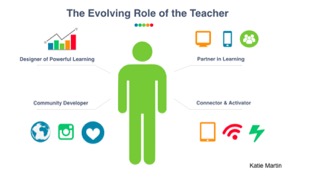
Katie Martin’s recent blog, “The Evolving Role of the Teacher”, offers an important break from “other-directedness” and addresses one of the areas we can control and can change.  She looks at the dissonance between the new knowledge we have about learning and the way this is experienced in many of our classrooms and schools. She offers a couple of examples’ one, which for obvious reasons, she doesn’t choose to identify and another, for equally obvious reasons she recognizes. Take a look…

A Tale of Two Classrooms

In this first classroom, the teacher is calling on her 5th graders, one by one to identify each of state and their geographic location. I talked to one of the students who told me they were learning the states because “the teacher thought it was important to know them” and when I asked if she knew a better way to learn about the states, she pointed to the iPad face down on her desk and said, “the Internet?” As I looked around the room, each of the students had their own iPad that was face down on the desk as they were copying the states from an Atlas into her map packet.

…this lesson, or some version of this lesson, is still happening in many “21st century” classrooms with an emphasis over compliance and standardization rather than deep personal learning. This example illustrates the challenge that exists in many classrooms when we add on new resources and expectations to an old paradigm of school.

Katie goes on to describe a different kind of classroom model. In Ms. Kim’s classroom

…a group of 4th grade students are engaged in a project where they are partnering with local business to understand their challenges and design solutions to impact their local community. In this classroom, groups of students are planning a pitch they are about present to the local water board. At the same time another group is designing a website for their business. Other groups are virtually collaborating with their organization to receive feedback on their product and building prototypes. The technology in this class allows all students access to relevant resources and to connect with people to learn, create, share and solve problems…

How do such variances in classroom/teacher practice vary so much? Ms. Martin provides a clear (and in my experience) accurate summation of where we are in our schools, noting that “Most educators in our schools and district offices have gone through their own education without the access and opportunities that exist today.“

Her analysis coincides closely with that offered by Dr. Phillip Schlechty in his book, Leading for Learning: How to Transform Schools into Learning Organization, published in 2011. Take a look at both Schlechty’s and Martin’s take on the necessary response.

Schlechty’s thoughts…

As a result [of new technologies] students are empowered to take on a more active role in the classroom, which becomes a shared space where teachers and students learn together and from each other. These newer technologies also give students a voice, where traditionally they had none, and provide an authentic audience of potentially millions.

Increasingly, students will direct their own learning and learning will happen in conversations, as opposed to structured lesson plans. And just as in life, learning will be connected rather than happening in isolation. All of this forces us to rethink how we do school.

So much of learning can and does happen outside the four walls of the classroom and with so many more people than the teacher. Learning doesn’t just happen between the hours of eight and three. It’s a continuous process for both teachers and students. We can no longer artificially filter what students are exposed to and instead have to help them learn to filter on their own. The lines between teacher and learner have to be blurred and the very idea of what is considered content has to be reconsidered.

Schlechty continues with a picture of what will occur if the transformation that he encourages does not take place…

And without transformation, about all that can be expected from school applications of new developments in the IT world is the digitization of past practices. More important is the fact that without the needed transformation, schools will play a less and less vital role in what the young learn and will be less and less important in shaping the worldviews the young develop. In the future, students will have increasing choice concerning the form their instruction will take and considerable control of the time and place that instruction will occur.

Remember, Phil Schlechty wrote these words in 2011. He wasn’t some guy peddling ideas on a street corner. Phillip C. Schlechty, who died last year, was an education researcher, speaker, and school-improvement advocate. He taught at both the K-12 and postsecondary levels, and served as a special assistant to the superintendent of Charlotte-Mecklenburg’s public schools. He also served in faculty positions and as an associate education dean at the University of North Carolina at Chapel Hill. Dr. Schlechty was the founder and CEO of the nonprofit Schlechty Center for Leadership in School Reform in Louisville, KY., an early initiative to create networks of school districts to experiment with and share best practices in leadership and student engagement.

It might seem that Phil wasn’t much of a futurist. Reading further, though, we see that he painted a picture of a future that seems pretty familiar and his words speak to us today. They add another dimension to our explorations.

With the advantage of an additional 5+ years of development to inform her sense of our needs, it’s interesting that Martin’s sense of the need, although adding some additional detail, does not differ substantially from Schlechty’s.

Martin’s thinking…

To meet the needs of the learners in our classrooms today and align school with the world we live in, there is a need to embrace new mindsets about learning, along with new tools and resources available to make these shifts across diverse classrooms.

She also echoes Schlechty when she notes that if we want our schools remain central in the educational lives of our young people our teacher must move beyond their learned roles of presenter of information, arbiter of what should be taught and when, assessor-in-chief – i.e., we must facilitate a shift in mindsets that both Martin and Schlechty advocate. So what are the ‘new mindsets’ that Katie is looking for?

Martin adds to Schlechty’s identification of needs that not only move the role of teacher from traditional teaching activities to a focus on the design of engaging learning experiences. Schlechty hints at and Martin expands that even this seemingly huge leap in role definition is not enough. She moves us beyond what we should not be to what she identifies as the new roles that we must embrace and enhance.

Her graphic portrays the roles that she sees as critical in the transformation process.

screen-shot-2017-03-01-at-11-52-44-am

Returning to her “Tale of Two Classrooms”, she uses her experiences in Ms. Kim’s room to add detail to each of the four roles she suggests.

Designers of Powerful Learning

The learning experiences described didn’t come from a curriculum guide. The experience was “co-constructed” with Ms. Kim’s students to achieve the desired goals. In both classrooms, students had technology – i.e., devices. However, they used them quite differently. Ms. Martin emphasizes that while technology can be a powerful tool, it “… no substitute for a teacher who designs authentic, and relevant learning experiences based on the unique contexts, strengths and interests.

Partners in Learning

 Ms. Kim and her students were learning together as they were collaborating with the businesses. She continues…

 When teachers embrace their role as a learner, everyone benefits. With so much information at our fingertips and new content and tools being created each day, it is impossible for anyone to know everything. Teachers and students as partners in learning models lifelong learning and empowers students to explore their passions and interests, rather than solely consume information.

Community Developers

Ms. Martin notes the importance of relationships and the teacher’s role in building such relationships. She adds to this that “the teacher’s role is pivotal in creating the community where students develop relationships with one another.” While the first classroom she described was compliance-based, Ms. Kim created community guidelines and established classroom meetings that “empowered learners to work together, seek to understand diverse perspectives, solve problems and communicate effectively” all of which are skills that are being identified within increasing emphasis by employers and higher ed institutions and which must be modeled and practiced in our classrooms.

Connector and Activator

Martin points out that Ms. Kim “designed opportunities for students to connect with one another…” but also with “with information and ideas beyond what she knew or could provide. She set up opportunities to connect with local businesses and provided the framework that empowered for students to solve relevant problems.”

Supporting the Evolving Role of Teachers

The actions and the implications for leadership…

The question for us as school leaders and as teachers was framed eloquently by Schlechty. His words are a challenge to us to assume control over the future of our schools/our classrooms, to treat learning and students as if minds matter more than the preservation of schooling as we have experienced it.

The questions are whether schools have the kinds of leaders needed to bring about such a fundamental transformation in the authority relationship between students and teachers, and whether the boundaries of the schools can be made sufficiently permeable to safely admit the information that the digital world makes available. Without such leaders, the transformation of rules, roles, and relationships that is required will not occur.

Martin adds to and balances Schlechty’s challenge to school leaders with “on the ground” observations.

…making these shifts across countless classrooms is more than equipping schools with technology or creating creative learning spaces.

To create powerful learning opportunities for diverse learners, teachers need to be supported to develop new competencies: skills, knowledge and dispositions to leverage resources and tools to support them in their evolving role. (Emphasis mine)

Critical points:

This is not about schools as “failure factories”.

This is not about teachers as self-serving, overpaid impediments to improvement.

This is about our willingness to move beyond “other-directed” explanations.

This is about the creation of cultures that embrace the new roles required to move our schools beyond organizations focused on teaching to the organizations we need – organizations focused on the process of learning, both for our children and for our adults.

This is about our willingness to move beyond the comfort of familiar zones of safety that we find in traditional roles of teaching and to explore the implications of engaging in the adoption of new roles.

Which of Martin’s new roles offers the greatest challenge for you?

Unknown's avatar

Moving Beyond Self-perpetuation: Two Stories about Action

screen-shot-2017-02-19-at-2-23-02-pm

By BK – ShareAlike 2.0 Generic (CC- BY- SA 2.0


When I began this blog I decided to call it ” rethinking learning”. I did that because, after visiting a number of schools throughout the country, I realized that much of the focus the recent reform era has been on improving ‘schooling’ and, many times, these efforts had too little to do with learning. The approaches used by No Child Left Behind and its successors focused on the act of teaching rather than on the process of causing learning.

In writing and talking about this with friends and colleagues it seems clear that moving the focus beyond the act of teachers (and blaming teachers for lack of anticipated progress) to the process involved in causing learning requires more than just thinking about learning. It requires action. And so that led me to look at why change oriented actions are so difficult for our schools and for our teachers.

In the last post I shared some thoughts about the tendencies of institutions (like schools) to self-perpetuate and protect the status quo and how fear frequently keeps us from attempting the kind of changes that we know are necessary but don’t know how to begin. One of shortcomings of our system here in the US is a tradition in which our professionals have significantly less time in their workday for professional growth and exploration than their peers in countries which are regularly cited as producing results superior to ours. I know that I now have much more time than many to find and read some of the many things available for my professional learning than I ever did as a teacher.

This past week I encountered two very different approaches to beginning the change process. I thought I’d share these with you as examples of how we can take actions that begin to increase our focus on learning and escape some of the less effective aspects of schooling.

The first of these comes from a post by Mary Tarashuk entitled “3 Ways My Students Assess Their Progress”. It’s a great piece and I urge you to read it in its entirety. In it, Ms. Tarashuk describes the struggles she has as a 4th grade teacher in the face of the increased pressured imposed on her and her students by the test and punish culture of the school reform agenda. She makes a connection between her own response to conferences with her principal when she receives her Student Growth Percentage and the response she sees in her students when they learn their scores on the now annual PARCC assessment. She writes…

I wish it wasn’t true. I wish that, the other week, when my principal called me into his office for my Student Growth Percentage, I wasn’t slightly curious about my score. I wish I could say, wholeheartedly, that I didn’t care about that score. I can’t.

Something deep within, from years ago, is still there. It tells me that my success is somehow defined by a grade…or in this case, a statistic.

For years, I’ve been frustrated and angry about standardized testing in general, writing about it ad nauseum here at my MiddleWeb blog. Dissecting it. Needing to uncover and expose the injustice of it all.

For years, I’d been finding more and more ways to “prove” that standardized test scores do not give an accurate portrayal of my individual learners, that the use of the data generated from these test scores should be examined more closely. So I really and truly wish that, when my principal told me I had scored well, I didn’t feel a tiny little flutter of something, deep inside my chest. I can’t quite describe this feeling, but I felt it…if only for a brief moment.

What Ms. Tarashuk is describing is one of the lessons learned in schooling… in her schooling and that of her students. But she goes on to describe an awakening she had as a result of her reading of a work by Dr. Brene Brown, Daring Greatly. She describes Brown’s research as it relates to education and how her work on shame and vulnerability applies to her work as a teacher.

Let’s face it. There are days when teaching children is like herding puppies. Kids are curious. They explore their surroundings, bumping into each other or crawling over each other to get to the next objects of interest. This is a good thing.

There are also days when I “fail” in the moment, when some of my own shortcomings – a lack of patience, or a lack of sleep the night before – can affect my relationships with my students, especially those who need a little “extra patience.”

I’ve seen shame in the eyes of my students…and I feel shame just thinking about the times I’ve been the cause of it. Dr. Brown believes that, “Shame corrodes the very part of us that believes we can change and do better.” Shame doesn’t belong in a classroom.

My experiences in my own schools and in schools I have visited leave me confident that the vast majority of our country’s teachers agree with Ms. Tarashuk’s statement, “Shame doesn’t belong in a classroom.”

So why have I included Ms. Tarashuk’s story in this piece? She is like many of us. As she describes, “For years, I’d been finding more and more ways to “prove” that standardized test scores do not give an accurate portrayal of my individual learners, that the use of the data generated from these test scores should be examined more closely.” Mary took action. I don’t know if she protested, wrote her congressmen, spoke before her board of education. I do know that she changed something in her classroom… in her classroom.

It’s why I chose her story. It’s not a new school. It’s not an instructional revolution. It’s just one thing. It’s the story of a starting point.

That’s where positive and constructive self-assessment come into play. I don’t want my students to feel shame. I want them to try to look at themselves (and the people around them) more realistically, and to learn to set personal goals for growth.

I share stories with my class about the life lessons I learned from my father. I’ve also shared the sadness that I sometimes still feel about his death, over a decade ago, especially when we come across a character that reminds me of him. We’ve laughed about my son’s potty training tales from days long ago. And they, in turn, share their family legend and lore with the group, safely, honestly, and often with no filter!

Mary offers an option for those who know there has to be more that we can do but who may be uncertain/fearful about starting as big as the problem seems to warrant.

The second piece  I’m sharing tells the story of the Apollo School… a school within a school at Central York High School in York, Pennsylvania. In this post, Jennifer Gonzalez describes a learning option made available to students at York Central.

This represents a step beyond the action taken by Mary and yet it remains well within reach for many teachers and students. In introducing the reader to the Apollo School, Jennifer asks the question we explored in out last piece last piece , “…why are so many teachers still using the same old model, where we plan and deliver lessons in separate subjects, in lock step, using the same traditional schedule as we always have?”

Jennifer offers two explanations. While I’m not on board with her first explanation.. “because it works… more or less”, I am in total agreement with her second…

The other reason we stick to the traditional framework is the one I believe is more powerful: It’s because we don’t know how to change. We have no template for what school could look like if we restructured it to reflect priorities like cross-curricular connections, student self-efficacy, and inquiry-based learning.

The remainder of her post offers a description of the Apollo Program…

The Apollo School is a program that operates inside a regular public school, Central York High School in York, Pennsylvania. Apollo is a semester-long, four-hour block of classes—English, social studies, and art—all blended together and co-taught by three teachers, one from each subject area. Throughout the semester, students are responsible for designing and completing four major projects, each of which is aligned with standards in all three subject areas.

Students set their own goals for each day based on whatever project they happen to be working on at the time: This includes independent and group work, one-on-one appointments with teachers, and attending optional, self-selected mini lessons taught by the teachers. By lunch time, when the Apollo block is over, students resume a regular schedule for the rest of the day.

 I urge you to read the entire article which also includes a video and transcript of an interview that Jennifer conducted with the program’s founders. If you find the program interesting and would like additional information, here is a program program website

What I wanted to share …

How the program started?

Two teachers organized the program in response to (a) their own observations about the problems caused by adherence to artificial content boundaries and (b) the district’s commitment to customizing instruction/learning for its students.

What are the Course Requirements: Curriculum and Assessment?

  • The program is theme-based
  • Students complete four projects per semester
  • Students are provided with the curriculum standards for each course
  • Students must correlate their explorations/investigations with curriculum standards and must demonstrate proficiency in each by the end of the semester
  • Students are assessed via a defense of the their project conducted by the three course instructors
  • Students are also assessed on how well they met four thinking skills—reasoning, perspective, contextualization and synthesis—and two “soft skills”—communication and time management.
  • Students may utilize any of the three “work” classrooms as well as the media center
  • Students may also elect to attend mini-lessons. Some are generic while others emerge as defined by student needs.

Given our experiences in schools as students and the enculturation process that takes place in many of our schools, it is understandable that many of the teachers who recognize the need for change simply can’t envision what steps they might take. Mary Tarashuk’s approach is being implemented in one the nation’s most aggressive large-scale assessment states. It is the result of an individual decision. It is one that requires only one simple statementI will.

The Apollo School requires more. It requires collaboration. It requires a culture that support and welcomes innovation. It does not require a new school. It does not require that all members of a school’s staff and community participate. It has one major idea I common with Mary’s steps… it has replaced “We can’t” with “We will”.

Please feel free to use the comment section to share with other readers additional examples of action that teachers, administrators and/or communities have taken to move beyond the culture of self-perpetuation.


Unknown's avatar

Why Change Doesn’t Seem to Change Much… Part II

In 2006, Sir Ken Robinson gave his first TEDTalk, “Do Schools Kill Creativity?” In the years following that talk, now one of the most viewed TED Talks ever, we have seen a growing number of highly regarded speakers offer increasingly harsh indictments of our system of education.

These talks, as well as writings on the same topic, draw on well over 50 years of experience with what is now referred to as ‘educational reform’. As I’ve shared in previous posts, the results have been disappointing, with minimal change in assessment scores and continued declines in student engagement (Gallup, 2015). A recent report published by the US Department of Education federal government revealed the latest disappointment when it revealed the following about the impact of the latest large-scale reform effort, the State Improvement Grant (SIG) program…

“Schools that received School Improvement Grants (SIG) to implement school intervention models used more of the practices promoted by these models than schools that did not receive grants. However, the SIG-funded models had no effect on student achievement, according to a new report released by the U.S. Department of Education.”

Mathematica Policy Research, January 18, 2017

Many of us have heard some version of the saying that ‘insanity is doing the same thing repeatedly and expecting different results’.

And the insanity continues. We are increasingly aware of the dissonance between what our students need to be prepared for in a rapidly changing world and the experiences they have having in our schools. Adding to the insanity is the reality that we continue to be increasingly aware of the flaws in our education system and, at the same time, we demonstrate that we are unable/unwilling to change that system. The voices of dissent grow in number and volume while we continue to tinker around the edges of the real problem.

For more detailed explorations of this disconnect, please look here, here, and here.

This has to change. The solutions – i.e., all of us doing the wrong thing better-  just keep getting us further from the real purpose of education.

So, continuing my reflections about leadership and change, I’ve been looking at (1) literature about the change process, (2) literature about the need to change schooling, and, (3) literature about the role of leadership,

Two things happened this past week that moved me to further extend these reflections. First, Will Richardson’s recent article entitled, “Zen and the Art of School Change”, showed up in my inbox. Then, a friend, knowing of my reflections/explorations around leadership shared a post from the Leading and Learning blog that featured an article by Robert Fried about the work of Seymour Sarason.

Richardson’s article flowed from his experience re-reading Robert Pirisg’s Zen and the Art of Motorcycle Maintenance. In writing about Phaedrus, Pirisg writes…

“…institutions such as schools, churches, governments, and political organizations of every sort all tended to direct thought for ends other than truth, for the perpetuation of their own functions, and for control of individuals in the service of those functions.”

Richardson asks if schools really do ‘direct thought to ends other than truth’ and, further, do they actually ‘perpetuate their own functions and control individuals in the service of those functions’? His answer is a resounding “yes”. So I added #4 to my explorations – literature about the ways in which institutions are designed for self-preservation.

Robert Fried writes thatSeymour Sarason is often described as a “sculptor of Ideas”, a “cautious radical”, and a “challenger of conventional thinking”, He authored over 40+books , including The Predictable Failure of School Reform. Here are the first entries from a list of Sarason’s ideas that Fried shares…

Every school has a culture that defines how the people within it operate;

The ‘regularities’ of the school’s culture – the rules and procedures, that are mostly assumed – tend to undermine the basic purposes of educating our youth;

The overriding purpose of the school ought to be that children should want to keep learning more about themselves, others, and the world, yet that is mostly ignored;

The educational “system” has an oppressive impact, stifling progress. The search for culprits – teachers, students, bad parents, and schools is a popular activity. The real culprit is the system itself;

The system, as it is currently functions, is intractable, not easily reformed. Its most significant feature is its ability to self-perpetuate”

And so I added #5 – literature about institutional cultures and the prioritization of culture over strategy

Consider Richardson’s observation about truth vs. institutional self-preservation when educators see the following slide from one of Richardson’s presentations. This slide is taken from one of Richardson’s TEDTalks (Vancouver). In it, he lists what we known about learning (truth) vs what we do most frequently in schools.

screen-shot-2016-04-09-at-4-07-32-pm

Richardson reports (and my own experiences showing the slide corroborate his experience) that the overwhelming response is “ah ha” in support of the obvious truth revealed in the slide.

Now let’s “marry” the new pieces of awareness… the tendency of institutions to value and promote self-perpetuation over truth and the ways in which cultures determine what will be accepted and incorporated into the organization.

For me these additions both clarify the roles of leaders and, at the same time, complicate the task of developing followership about ideas/truths that run counter to the regularities of behavior that have served and continue to serve the interests of institutional self-preservation.

I’ll add yet another force that complicates the development of followership – fear. As Sinek points out in his work on trust and circles of safety, we tend to come together to protect ourselves from danger – i.e., our decisions to join others to get safety are fear-based based.

Michael Fullan offers in “Core Principles As a Means of Deepening Large Scale Reform” that a critical role of leaders is to drive out fear.

In building a culture of action one of the most critical elements is what happens when things go wrong? Actions, even those that are well planned inevitably entail the risk of being wrong.(p. 253)

Does the culture have a “learn from mistakes orientation or does it treat failure harshly?”

[… ] Fear fosters knowing-doing gaps so drive out fear.

 Organizations that are successful in turning knowledge into action are frequently characterized by leaders who inspire respect, affection or admiration, but not fear. (p. 256)

So to return to an earlier question…

Why have the voices like Zhao, Robinson, Sarason, Richardson, etc. produced such meager and impotent support/agreement? If the self-perpetuation factor is a one of the keys to aligning Sarason’s purpose for education with what actually happens to youth, what is it about the institution that is so durable as to be able to resist the acceptance of the “truths” – i.e., Where does the dismantling of this self-perpetuation begin?

I’m thinking it begins with fear, both the identification of the fears that drive the perpetuation of the familiar as well as the fears of that accompany exchanging the known (regardless of identified shortcomings) for the unknown.

Note: I’m also thinking that this fear-based explanation also connects directly to Sinek’s concept of trust and the leader’s ability to create the “circle of safety” and that, quite frequently, we are unaware of the fears that are subtly “steering” our decisions.

What happens if we begin with an examination of the fears faced by the various stakeholders in maintaining the status quo? And then move to concrete actions that lessen the sense of fear?

  • What are the fears facing participants in school governance?
  • What are the fears facing those employed by the system?
  • What are the fears of administrators (district and schools )?
  • What are the fears faced by teachers? Do they change with age and experience?
  • What are the fears faced by parents?
  • What are the fears faced by students – i.e., I know how to play the current system? Can I be successful in anew system?
  • What are the fears faced by members of the community?
  • What are your fears in considering the recognition and modification of the culture of self-perpetuation as reflected in your school/district?

Note: This past week, I had the good fortune to attend a program in Washington, DC organized by Derrick Harkins, Senior Vice President of Union Theological Seminary in NYC, and Marianne Williamson. One of the first exercises we were asked to do was, coincidentally, to take a moment and silently name at least one fear that we recognize as limiting our lives. I say “coincidentally” because I had already written the above section on fear prior to this event. It was a powerful moment as evidenced by the absolute silence of the approximately 2000 participants.

Suggested actions:

  • Carve out 10 minutes from your schedule.
  • Be alone.
  • Identify no more than three fears that you feel are limiting your willingness/ability to achieve what you want most to achieve.
  • Write them down.
  • Quietly reflect on one of these, and
  • Write down your thoughts as you experience them in this quiet time

What are you going to do about it?

Unknown's avatar

Personalizing Leadership Development

Note: This is a follow-up to two recent posts in which I offered suggestions for a self-reflection on the key concepts leading to leadership. For those interested in continuing the exploration of leadership/followership and the related components, I‘m offering a list of resources that I’ve found particularly helpful in my leadership coaching work.

This is, by no means, intended to be a comprehensive list. Rather it might serve as a starting point for further exploration of components which you may have found interesting or you’ve identified as worthy of additional attention.

Some additional context… the importance of purpose and vision in the exercise of leadership and the development of followership

sheep-img_1145-1

From The Far Side Gallery 4 –Enter a caption

In revisiting the pieces that I’ve shared about this topic, I realize that I shortchanged the importance of vision and moral purpose as the driving forces for leadership work. To make up for that oversight, I’ve added a section of resources devoted just to these. As I’ve tried to emphasize throughout my writing, there is a critical difference between doing things right and doing the right thing.  Without the clarity provided by the development of a strong sense of moral purpose and a vision that focuses on why we are doing what we are doing, we greatly increase the risk of simply doing wrong things better.


Moral purpose and vision form the foundations for the development and exercise of leadership. The attention to vision and moral purpose serve as the guidepost for our leadership journey. In his little book on the life of St. Francis, Francis: the Journey and the Dream, Murray Bodo ofm offers the idea that the dream (our vision/purpose) is what drives the journey. Our journey is what makes the dream possible. They exist in a mutually supportive relationship.   Without the dream, there is no reason to continue to struggle with the rigors of the journey. Without the trials and struggles of the journey, we can never attain the dream.

I am convinced that. too frequently, our school communities have been exhausted by the rigors of the journey without the vision of the dream that guides us. It is that vision and that purpose that encourage participation in the hard work of the journey. It is leadership that guides, supports, and validates that work.

Lastly, while I have listed the components of leadership as discrete concepts, they exist in relation to one another. They build upon and interact with one another. As such, any assignment of resources to a particular category/components is, at best, an artificial distinction. I have led off with Vision/Purpose primarily because too often in my work, I’ve encountered good people trying to do things right, with little or no inclination or encouragement to consider whether or not it was the right thing.

 Vision/Purpose –

 My intent with the selection or resources offered here is not to suggest your vision/purpose. It is intended, however, to provide a frame of reference for your reflections. I believe and have emphasized elsewhere that the default vision and purpose for our education “system” has become schooling and how to do schooling better. The resources I’ve included here offer alternatives to that direction and purpose. In some way, each encourages us to ask “why” we are doing the work we are doing.

 Sir Ken RobinsonRobinson’s TED Talks are among the most viewed TED presentations worldwide. The thinking and language expressed in his talks and in his writings can provide educators and members of the education community with concepts useful in the conversation about purpose and vision.

Robinson – Booksbooks deal with the premise that while the current focus on standards is necessary but not sufficient. They focus on the need to help student discover their passion and the need to focus attention of the development of creativity in all children.

  • Creative Schools: The Grassroots Revolution That’s Transforming Education
  • Out of Our Minds: Learning to Be Creative
  • Finding Your Element: How to Discover Your Talents and Transform Your Life
  • The Element: How Finding Your Passion Changes Everything

 Robinson – Video Talks

Changing Paradigms in Education – Sir Ken challenges the way we organize teaching/learning

Escaping Education’s Death Valley– Sir Ken offers thoughts about the how we might organize learning

Simon Sinek – TED Talk

How Great Leaders Inspire Action – One of two citations for the work of Simon Sinek. In this TED Talk, Sinek addresses the critical importance of clear purpose, the sense of “why” we do anything.

Dan Pink – RSA Animate version of Pink’s TED Talk, Drive. One of the nation’s leading thinkers challenges traditional thinking about what motivates adults (and kids).

Will Richardson – Book

Why School?: How Education Must Change When Learning and Information Are Everywhere – moving education and learning beyond the walls of the school. Richardson has a rich array of TED Talks, writings and blogs around the topic of the learning and schooling.

Clark Aldrich – book

Unschooling Rules: 55 Ways to Unlearn What we Know About Schools and Rediscover Education – deceptive title… this little book provides an interesting blueprint for what should be the cornerstones of learning programs. Education should consist of three types of learning: (1) learning how to learn, (2) learning how to do, (3) learning how to be.

John Seely Browne – book with Douglas Thomas

A New Culture of Learning: Cultivating Imagination for a World of Constant Change – Adds thoughts on engagement, passion, etc. His video gives a great example of how kids are using the internet to create learning communities that are not bound by any walls.

A final thought about vision/purpose…

I imagine that, in your time in education, you have engaged in any number of conversations, discussions groups, planning sessions, etc., all dealing with the development/refinement of the school/district’s vision statements. Am I suggesting that these all fall short? No, I’m not. But what I can share is this… In the past ten years or so that I have been traveling and spending on average 10-15 days a year in the schools where I work, I have seen numerous vision statements and almost no intentional actions intended to assess or promote the achievement of the stated vision. Publicly posted statements of vision/purpose accompanied by no discernable intentionality of action do not reflect well on the exercise of leadership.

Conversations/ Relationships –

 In contrast to the rich offering of resources relating to vision/purpose, the recommendation for this component may seem quite meager. I’m reminded of a popular TV commercial from some years ago in which an announcer offered a flowery and glowing introduction for the speaker, extolling the depth of his knowledge and expertise. The speaker then walked onto the stage, looked out at the assembled crowd, said “Wassau” and left the stage. There is really only one resource needed for the incredibly important topic of conversations and the connection between effective conversations and positive relationships… Susan Scott.

Scott not only builds the rationale for what she terms “fierce conversations”, she provides a step by step training for the development and honing of the skills involved. Her works are thoughtful, humorous, and hands-on. She begins with the premise that few of us have had the luxury of any kind of formal, intentional training in preparation for “challenging” conversations. My interviews with teachers, leadership candidates, school leaders, district leaders, etc. affirm her assertion.

Note: Although the overwhelming majority of those interviewed indicated that they would rate themselves less than satisfactory on their confidence to guide productive difficult conversations, there persist significant barriers for individuals to commit to the practice of Scott’s suggested steps. In some ways this reluctance appears not dissimilar to trying to break a bad habit. It’s tough to do without support.

The most successful instances of people learning to feel comfortable with Scott’s approaches are those who were able to work together with leadership colleagues to discuss the process, try it out and, apparently of greatest importance, discuss the experience with those colleagues. It’s tough to do alone.

When wondering if it’s really worth the effort, you might focus on Scott’s observation in her work with organizations and organizational leaders… solid relationships are critical to the development of the kind of trust that must be present to allow risk taking to occur  while solid relationships are built one good conversation at a time, poor relationships are created one poor conversation at a time.

I’ve included here both of her works on the relationship between conversations and relationship building. I would suggest beginning with Fierce Conversations. If you find it as helpful as participants in my coaching, you will most likely also read Fierce Leadership.

Susan Scott – Fierce Conversations – the most powerful book that I’ve encountered in my time as a school leader and executive coach.

Susan Scott – Fierce Leadership – the extension of the fierce conversation approach to leadership. Neither book is specifically about school; however, they are both totally about school.

Trust and creating the Circle of Safety

 Simon Sinek –  Why Good Leaders Make You Feel Safean informative and inspirational talk in which Sinek describes the Circle of Safety and the things that good leaders do to build trust and security.

 James A. Autry – Book

The Servant Leader: How to Build a Creative Team, Develop Great Morale, and Improve Bottom-Line Performance – a look at a different approach to leadership and the ways in which trust is developed.

Tom Sergiovanni – Book

Moral Leadership: Getting to the Heart of School Improvement – This work probably could have fit into any of the component categories. For the first half of his career, Dr. Sergiovanni focused on the mechanics of supervision and evaluation. Having witnessed the failure of such approaches to make a difference in the quality of learning experiences for students, Dr. Sergiovanni spent the most productive years of his career speaking and writing about building learning communities, the importance of the development of followership and the role that moral leadership plays in this process.

 Followership

Note:  I believe that Followership is less a strategy or skill than a condition. It is the condition that can result when there is clear vision/purpose and the commitment to the development of a culture characterized by honest, meaningful conversations, the nurturing of caring, supportive relationships inside a web of trust and safety. Followership does not imply a mindless obedience to the dictates of someone with greater authority. It is rather the deliberate decision to participate collaboratively in a community dedicated to the pursuit of a dream, vision, sense of purpose that engages us at a deep part of our being. It is a voluntary belonging.  

 Phil Schlechty – Book

Leading Learning – an extension of the Engaging Students book that concretely addresses the steps that leaders can/should/might take to cause learning in both kids and adults in response to our current challenges

End thoughts – While it seems plausible that each generation of educators might look at its own time and describe it as one of great challenge, there seems to be something “special” about this time. Regardless of the accuracy of this perception, there is the unfortunate sense that our public schools are failing. We are seeing increasing challenges to the continuation of schooling as we have experienced it, both as students and in our work. We are seeing the denigration of the profession to which many of us have devoted a substantial portion of our lives. I’ll be connecting leadership to these challenges in the next post.

Be well

Unknown's avatar

Building Followership

Beginning Steps in the development of self-reflective tools for the Leadership

Note: Based on requests, this piece is the beginning of a “crowd sourcing” experiment. After a brief introduction to provide a bit of context, I’m going to share a beginning list of self-reflection prompts for the assessment of leadership/followership. My goal is to make this a work in progress and to have you add additional questions that might be used in self-reflection. It is not intended to be a complete guide or eventual product. It’s a starting point. I hope you’ll feel free to try it out, modify it as you like and share it with a kindred spirit. I encourage you to use the Comment option of this blog to share your experiences and suggestions with others. You can also use my email at rteneyck42@comcast.net to add your thoughts.

In a recent post I shared my observations about the path to leadership. I want to add a few thoughts to the concept of leadership before addressing the path to it.

Leadership is an ongoing process. It neither begins nor ends with the acquisition of a title. It involves both means and ends. Leadership involves the recognition of the ownership of the responsibility for nurturing, supporting, challenging our relationships and followers around a commonly held vision/purpose.  In Leading in a Culture of Change, Michael Fullan offers…

Whatever one’s style, every leader, to be effective, must have and work on improving his or her moral purpose. Moral purpose is about both ends and means. Authentic leaders, in other words, display character, and character is the defining characteristic of authentic leadership…

Moral purpose cannot just be stated it must be accompanied by strategies for realizing it, and those strategies are the leadership actions that energize people to pursue a desired goal.

Here’s a quick recap of I shared as critical strategies in the development of Leadership:

The keys to Leadership:

Conversations – open, honest, caring conversations lead to Relationships.

Relationships – solid, confident relationships lead to a sense of trust or feeling of security inside a “Circle of Safety”.

Trust/Circle of Safety – provide us with the willingness to take risks, a sense of security that we will be protected and that we would do the same for others inside of our circle – i.e., we are willing to follow those whom we trust.

Followership – willingness to follow those whom we trust, knowing that we can have open, honest, caring conversations about our concerns and that our relationship is important to our leaders.

The components that I’ve offered her are not meant to be exhaustive. The leadership process is an ongoing interaction of skills/dispositions, relationships, and situations.  I’ve elected to focus on the “Keys to Leadership”  because, as I’ll discuss next, they have been more causal in success/failure than many of the concepts treated formally in leadership programs.

While I’ve listed the components in a linear forma, they are constantly interacting and reinforcing (or impeding) one another.  Quality conversations don’t stop when a good relationship has been developed.  Attention to relationships doesn’t end when we perceive that people now feel safe.  While good conversations lead to more positive relationships, such relationships also lead to better and deeper conversations.

My thinking on these components stemmed both from a conversation with Tom Sergiovanni and my experiences working with more than a hundred schools during my years as an education consultant. Dr. Sergiovanni expressed the concept quite clearly… “Leadership is the capacity to create followership”. He followed that statement with another, “If you look behind you and nobody’s following, you ain’t leading!”

After unsuccessfully trying retirement for the second time, I was blessed to have the opportunity to work for more than ten years with some exceptional educators at the International Center for Leadership in Education (ICLE).   In my capacity as traveling consultant, I had the chance to work with school leaders and teachers throughout the country. A number of these experiences were very successful. Others were less so.

In many instances, the need for improvement was not questioned and the challenge for me was to build followership among school leaders around strategies that might result in desired improvement, including the development of followership among staff and students around the improvement initiative. In other instances, the primary task was to build followership around purpose among school leaders who had been directed to produce better results but who had little or no emotional connection to the project.

As I reflected on the range of experiences (both successes and failures), I initially fell into the trap that I had so often seen with school leaders and educators in schools that I visited… explanations for lack of progress that were too frequently “other directed” – i.e., if only the students would work harder, if only the teachers would try new things, If only “they” would… etc., etc. etc.

In my initial self-reflections, my version was equally “other directed” – if only the principal would exert more leadership, if only the teachers would place learning as the highest priority, etc., etc. etc. Only closer to end of my career have I begun to recognize that my reflections needed to be “inward directed”. What had I not done (or done poorly) that accounted for the lack of followership?

screen-shot-2017-01-22-at-1-44-44-pm

Creative Commons – Jennie

It was then that I had another epiphany (see post here about the first one). I saw a connection between things that I had been reading and treating as if they were isolated thoughts instead of interlocking puzzle pieces.

My puzzle pieces: As I mentioned previously, I had become aware of the relationship between leadership and followership due to my encounter with Tom Sergiovanni. I had learned from Simon Sinek’s TED Talk about the “Circle of Safety” and had encountered the connection between conversations and relationship from my readings of Susan Scott’s works, Fierce Conversations and Fierce Leadership. But the epiphany came when I saw the connection among these and started to apply them to my own self-reflections.

What follows is a bit of a synthesis of my own process of self-reflection – the questions that I’ve developed over time and have used to assess my experience trying to build followership.

The self-assessment: Ideally, this should be completed as a self-reflection and also, minimally, by a cross-section of prospective “followers”. The addition of response from “critical friends” will facilitate the discovery of areas of dissonance… areas in which self-perception and “follower” perceptions differ significantly. Implicit in the process is the identification/exploration of growth steps in areas which seem to require additional attention.

Based on some trial uses, I’m suggesting that you use the following scale in response to the statements. Recording these responses enhances the likelihood of seeing patterns as well as possible priorities for attention.

Suggested scale: 1 – Never; 2 – Occasionally; 3 – Often; 4 – Always

For Conversations

  • I am highly present in my conversations.
  • I establish and maintain eye contact.
  • I listen at least as much as I speak.
  • Participants feel heard/listened to at the conclusion of our conversation.
  • I shy away from difficult conversations.
  • I am always honest in my conversations.
  • There topics that are not discussable in my work.
  • I feel secure in having/initiating difficult conversations.

For Relationships

  • I am intentional about building and maintaining relationships with staff members.
  • I am inclusive in my relationship building efforts.
  • I am comfortable with my relationships at work.
  • I deal well with people with whom I am uncomfortable.
  • Members of the staff see me as caring about them.

For Trust/Circle of Safety

  • I see myself as trustworthy.
  • I identify any issues/actions which weaken the sense of trust in my leadership.
  • Staff members feel safe taking risks under my leadership.
  • I identify any specifics risks taken by those under my leadership.

For Followership

  • I have a clear sense of my vision for our school.
  • I have communicated this vision to staff.
  • The staff understands my vision.
  • There is observable commitment to this vision by the staff.
  • I have a cadre of people I can count on to support my vision.
  • There is a segment of the staff that does not agree with/act in support of my vision.

For Leadership

  • I have a clear vision for my work.
  • I effectively communicated that vision?*
  • The vision is well understood.
  • I been intentional about the development of the achievement of that vision.
  • I been inclusive in my involvement of colleagues and staff in the work.
  • We developed measures to assess the achievement of the vision.

What’s Next?

OK, so I didn’t do so well in my self-reflection on conversations. Or, man, I suck at relationships? What do I do?  In my next post, I’ll be sharing an annotated list of resources, grouped by the components of followership/leadership… places where I’ve been able to find starting points for areas that I identified in myself (or mentees) for growth.

Your turn…

Is this framework useful for you?

What could be changed to enhance your use of such a tool? – i.e., What can you add, modify or delete to help create a picture that you would trust as guidance for assessing/improving your capacity to develop followership and achieve your vision for your school’s learning community?


Unknown's avatar

I’m sorry. I lied…

screen-shot-2016-10-29-at-4-08-56-pm

Pogo the Possum’s quote for Earth Day, April 1970 – Walt Kelly

I shared in my last post that this post would be dedicated to looking at the process of leadership, followership, self –reflection and the first steps to beginning a leadership self-assessment. I lied. At the time I didn’t know I would be lying but…


I find the times unsettling.

I suspect it is fair to conclude that most of us have found the election and post-election activities exciting… exciting in the sense that they generate emotion. Whether these emotions are hope or fear based, it is hard to escape the reality that we may be in for a time of significant change.

I thought I wanted to write about it. I started a piece which quickly became three pieces. I couldn’t make sense of them. I certainly couldn’t expect you to. I looked for connections. Connections were elusive. I watched the president’s farewell address. I was inspired. I was moved to tears. I watched the president-elect’s news conference. I felt like sticking needles in my eye. Wouldn’t it be ironic if the person who inspired me is remembered for ineffectiveness and the person whose thoughts scare me turns out to be effective.

What I want to write is challenging. It’s challenging because it’s critical of the culture of the system in which that I’ve spent almost my entire professional my life. It may be perceived as insulting. I don’t want it to be.

There are lots of things I don’t know about. I don’t know much about international trade deals. I don’t know much about national security. Or quantum physics for that matter. I know less about building walls. But I do know about education. I know this from angles that most folks haven’t had the chance to enjoy.   And here’s what’s challenging. I know that we, as educators, have earned much of the criticism that we are receiving and which threatens now to upend our world.

borowitz-img_0291No, it’s not all our fault. We’ve had the real life version of “A Confederacy of Dunces” telling us what was wrong and what to do and how to do it. Whoever thought that the National Governors’ Association would be a good group to determine what should be learned in our schools? Why would anyone think that a group who could come up with names like No Child Left Behind or Race to the Top or, as a sign of decreasing creativity, Every Student Succeeds could actually develop policies that made sense. No, it’s not all our fault.

But we’re complicit, far too complicit.

It’s why I pulled up the Pogo cartoon. Not because we are greedy, lazy, selfish, fat and happy as too many so-called “reformers” assert. I chose the cartoon to ease into the possibility that we may have spent so much time preserving the comfort, the familiarity, the efficiency of schooling that we have failed to respond to reality that schools designed to meet the needs of the 19th and 20th centuries are not suited to meet the demands of this time.

In an earlier post, I referenced a recent Gallup poll which revealed that student engagement levels in our schools drops from near 80% in early elementary grades to around 40% by a student’s senior year. I noted at that time, that if Walmart or Amazon experienced a similar drop in customer satisfaction, their response would not be to continue business as usual.

This morning I had the chance to read the latest post by a young teacher, Jay Armstrong. He writes on a variety of topics and I highly recommend his work. In this piece, he describes an encounter he had with a young graduate who dropped by to see him during the winter break from the college he was attending.   He describes a young man (“M”) who was considered an excellent student in an excellent school system. He was not doing as well in college and he was confused. He asked Jay…

“So what’s the point of school? Because I always thought it was to get good grades. Follow directions. Get a diploma. A means to an end, you know. That’s what my dad always says. But after twelve and a half years of schooling I’m really confused.  I mean really, what’s the point of school?”…

Jay continues…

“See, M was a “good student”. He was respectful, compliant, met deadlines and studied all his notes. And the system rewarded him for with a diploma for his obedience.

Unfortunately, the system never challenged him how to think on his own, to problem solve beyond rudimentary worksheets or to provide himself the audacity to question.

M was lead to believe that a grade of an A meant perfection. It meant there was nothing else to learn.

M admitted he was scared to death to be wrong, to make a mistake. For years he equated his self-worth with his grades. He believed success in school meant success in life.”

I don’t believe that this is an isolated experience. On the contrary, I believe that M’s experience is typical for far too many of our children. The calls for change that we are seeing now and the proposed solutions range from ill-informed to downright stupid. But “M’s” question gets to the heart of the matter. What IS the point of school? This is a question worth asking and it is increasingly apparent that it is one that we, as educators, better answer. For those of us who have devoted substantial portions of our lives to a career in education, the prospect of change and growing acceptance of the need for change is daunting.

We have not responded well to change. Not because we are educators but because we are human. When confronted with change, change which might disrupt the sense of safety and security we have managed to create in our schools, in our classrooms, in our minds, we have too frequently exclaimed “we can’t” when we mean “we won’t”. With the best of intentions we have tried to preserve schooling as we experienced it. We have ignored that ‘schooling as we know it’ has worked best for people like ourselves and far less well for those who aren’t.

As this piece has evolved, I realize that I didn’t really lie. This is precisely about leadership and the need for us to exert the kind of leadership that answers M’s question. To build the followership among colleagues and our communities that will be necessary to reveal sloppy thinking as sloppy thinking, to highlight that trying to do the wrong things right serves neither parents nor students, nor our profession well. This can’t be a time for fixed mindsets.

NOTE: I began to develop this piece after reading an extensive report which detailed the shortcomings of the “free market” approach to school improvement.  I had in mind providing readers with the kind of background that might be helpful in any discussions that might occur as the move to vouchers, choice, and privatization heat up. As you have probably noted, the piece went in a different direction.

Embedded in the report, however, was the story of a man I met quite some time ago and who was instrumental in the development of the voucher system implemented in Milwaukee in the 1990’s. Dr. Fuller, a noted civil rights activist, invested his life in trying to find better opportunities for poor, minority families and their children. As superintendent of schools in Milwaukee and frustrated with his failure to gain community support for his efforts to improve the experiences available to poor, black children, he became the architect Milwaukee’s voucher program.  Last night when I heard John Lewis speak with such deep conviction and quiet dignity, I was reminded of the struggles and courage of Dr. Fuller. In my mind, he picked the wrong solution but I felt it important to highlight the world of difference between the motivation of Howard Fuller and ideologues like Betsy DeVos. I hope you read the report.


Unknown's avatar

Why Change Doesn’t Change Much…Leadership in the post-election time


Recommendation: With an occasional exception, the focus of my writing continues to be centered on ways to improve learning and the processes involved in facilitating that focus. It’s where I’ve spent the majority of my career. My focus is not intended to minimize the importance of political action and ways in which political action may support or impede the improvement of learning. As I have in the past, I urge you to follow the writing of Jan Resseger for the policy side of educational issues. She is an ardent supporter of public education and a wealth of information and resources for folks seeking to become informed about education in the post-election time. Thank you.

Why Change Doesn’t Change Much…Leadership in the post-election time

middle of nowhere_1129

From the The Farside Gallery 4, Gary Larson


During the holiday break, I found myself returning repeatedly to the implications of the president-elect’s proposed nominee as Secretary of Education. I’ve found myself swinging between the exciting possibilities for change and the desire to ask my doctor for some strong anti-depressants.

Regardless of which end of the spectrum I found myself, I realized that the word which was dominating my thoughts was “change”. I also realized that, in spite of all of the changes we have seen in the quest for educational improvement, school reform, elimination of achievement gaps, etc., we have seen very little change in the way we educate our children. Oh sure, we’ve seen significantly different areas of focus: behavioral objectives, values clarification, content standards, large-scale state assessments, etc. We’ve also seen our share of “band wagons” and also our share of “train wrecks”. But with a few notable exceptions, all this change hasn’t changed much.

Why is that?

Spoiler alert… I’ve written elsewhere about the increasing awareness that the majority of change efforts that we have witnessed have been examples of trying to do the wrong thing (schooling) better at the expense of doing the right thing – focusing on learning. But there are many factors which are at play in making change result in actual change/transformation. In this piece, I’ll focus on one of these factors – an exploration of a critical connection – the connection between successful change, leadership, and adult engagement. In the second piece in this series, I’ll focus on intentional actions that can increase the probability of positive impact.

So here goes…

For past the 10 years, most of my consulting work has revolved around leadership and leadership coaching. I’ve learned some things and I’ve unlearned others. Here’s what I’ve learned. Many might characterize these as beliefs and I suppose, in some ways, they are; however, I sense that they are more than that because I have seen this work.

People rarely quit jobs. They quit bosses. This “quitting” may be in the form of actual departure, but in many cases, it’s a kind of virtual departure… they just “checked out”. (BTW, one can extend this ‘quitting notion to kids, teachers and content – i.e., kids quit teachers far more frequently than they quit content).

People stay in a job, engage (and stay engaged) when there is a clear sense of purpose (one that they can buy into), when they are trusted to have some autonomy, and when they feel that they are growing (getting better) in their work. See Dan Pink, Drive

Where does this engagement, this sense of purpose, this autonomy, this sense of growth come from?

Leadership. Plain and simple, leadership.

There is a direct and causal relationship between and among 4 factors that enable successful leadership:. Beginning with the end in mind, I’ll begin with followership.

FollowershipLeadership can be defined as the capacity to build followership. This assertion comes from a conversation with Tom Sergiovanniwho for years was the leading author of texts used in courses for supervision and leadership. See Moral Leadership: Getting To the Heart of School Improvement. In a presentation I had helped organize, Dr. Sergiovanni noted leadership is based on stewardship and service, not authority, rules or personality…that if you looked behind you and didn’t see anyone following, you weren’t leading.

So how is followership built?

People follow those whom they trust and who make them feel safe.

It is this belief that Simon Sinek, refers to as the Circle of Safety in his TED Talk, “Why good leaders make you feel safe”.

And how is this “circle of safety” and sense of trust built?

It is built through relationships. We have seen this over and over again in classes where students go the extra mile because of the relationship that exists between them and the teacher. We have felt it when, as adults, we extend and even inconvenience ourselves for people who care about us.

And how are these relationships grown and nurtured?

Susan Scott in her work on communication (see Fierce Conversations and Fierce Leadership) shares that such relationships are built or destroyed one conversation at a time. They are destroyed though impersonal, perfunctory, or insincere exchanges. They are built through deep, caring, honest conversations. These are not conversations held via email, they don’t take place in large groups. They occur face-to-face and are sometimes, as Scott describes them, “care-frontational”.

Relationships that come from such conversations foster trust and a sense of safety for risk taking. Such relationships foster in us the confidence that we are not alone and that we will not be asked to do what our leaders/ colleagues would not do themselves.

And so people confer leadership to those who have fostered these building blocks. These factors build upon one another and enhance the development and articulation of a clear sense or purpose/vision which can be shared and understood. When present, these conversations, the development of caring, supportive relationships, and the sense of trust that results from these build the kind of followership that allows the realization of that vision/purpose.

When these conversations, relationships, and trust are absent or only superficially developed, change initiatives, regardless of the nobility of their intent, falter. Want to test this? Recall an initiative that was considered high profile only a few years ago that has been replaced by another such “miracle cure”. I’ve worked in districts where we could have filled wall with post-it notes, each representing a program or new initiative that is no longer in use.

Question: Why did these fail? Why did little or nothing change (other than an unintended increase in willingness to be a part of the next great idea)?

Answer: Lack of followership!

Now look at the intentionality of the efforts. How clear was the purpose? How was it communicated? Who was involved? How frequent and honest were the conversations about the implementation? Who nurtured the relationships? Who made it clearly safe to risk and possibly fail? What was the level of followership that developed?

Here’s what happened to me as I was writing this piece. I found myself reflecting upon my time as an aspiring leader, as a titled leader, and, occasionally, as a good leader. I found myself not liking all that I saw in my reflection. I found things that I would love to go back and undo. I found times when I was blissfully unaware of my role as relationship builder or as role model for meaningful conversations. I recalled times when I saw no one behind me and blamed them.

My reflection didn’t grant me any “do overs” but it did push me to offer such an opportunity to you. And it’s a lead-in to the next post…how to conduct a self-assessment and how can we be intentional about maximizing the interaction of the factors I’ve shared as critical to the development of followership.

In researching some of the resources included here, I recalled a conversation I had one time with Dr. Tom Sergiovanni.  By the time I met him, he had enjoyed a long and successful career. In our conversation, Tom openly shared his disappointment with his earliest work. Leadership, he offered, was not about mastering the mechanics of supervision and management “Leadership, “ he said, “is about the capacity to build followership.”

Struck by this memory, I decided to revisit Tom Sergiovanni’s career and contributions. Dr. Sergiovanni died in 2012. Here’s an excerpt from his obituary contributed by a colleague who recalled the following quote from his friend…

“…the work of educators (should) involve not only their professional skills, but their hearts and souls as well in their commitment to the human integrity of the work of educating the young.” (Read more…)

As homework, I invite you to begin the reflection by responding to just two questions.

How is your heart and soul reflected in your leadership?

What are the challenges you face in bringing this to your work?

That’s the beginning of my next piece…

PS The keys to good leadership didn’t change with the election ♥

Unknown's avatar

Because it is You (Sic) Choice

Happy New Year! There is something very special about this holiday season. Whether you celebrate it in the context of a religious tradition or simply enjoy the sights, sounds, and family gatherings, I hope you have been able to find and share peace, joy and love during this time. My continued wishes are for health, curiosity and engagement for the New Year.

I’ve been thinking a lot about the terms intentionality, leadership and change and, in the next few posts, I’ll be sharing some thoughts about these,  why change doesn’t seem to change much, and how we can make change happen.

Coincidentally, as I was reflecting on this, I had the chance to have lunch with a long time friend and colleague during the break and, as expected, we spent considerable time talking about our experiences and what the recent election might mean for education. A few days later, Bernie shared the following memo he had sent to his staff when he was a principal and following the presidential election of 2000 which, prior to the recent election, was only the fourth in U.S. history in which the winner failed to win the popular vote.

Because it is You (Sic) Choice

As we enter the DeVos Times, I offer the following essay written as a high school principal for my parent newsletter 16 years ago on the occasion of the “electoral traumas” of the 2000 presidential election.

Bernard Josefsberg

A recent report included among the evidence justifying New York State’s recent school finance court decision the decrepit conditions in P.S. 187 in New York City’s Washington Heights This reference held more than academic interest for me: my own schooling began in P.S. 187, and I still have clear memories of my four years there. Standing under Charles Wilson Peale’s dour portrait of George Washington, I learned the Pledge of Allegiance. In those days, establishing and promoting that allegiance was an unabashed purpose of our public schools.

Many aspects of the current educational and political scene would make it difficult for Dour George to lighten up. In much the same way as P.S. 187 has fallen into disrepair, weeds have crept into our civic space. We seem to educate less for democracy and more for money. As a result, our democracy elicits less intelligent passion from us than it requires while our economic anxieties absorb more of our attention than any other purpose for schooling.

In this vein, the filter of Election 2000 casts some interesting shadows on recently released data from the National Assessment of Educational Progress (NAEP). At issue are the persuasive writing abilities of American high school seniors, Class of 1998. One of the prompt topics used in this assessment required students to advocate a position, either for or against, on the efficacy of voting — i.e., does one person’s vote make a difference, and therefore should one bother to turn out on election day. Responses were rated for quality (as opposed to the position taken) on a six point scale ranging from “unsatisfactory” to “excellent.” Ratings between these two poles included: “insufficient response”; “uneven response”; “sufficient”; and “skillful.”

Four percent of the tested population turned in “unsatisfactory” responses on the order of, “If you want to vote go for it. Because it is you (sic) choice.” Three percent produced “excellent” prose as suggested by the following essay introduction: “Whether a single person’s vote makes a difference in an election is irrelevant. A democratic nation is one that recognizes an individual right to think and formulate an opinion, and voting is a manifestation of that right.”

Between the poles, the population arrayed itself as follows: Insufficient = 21 %; Uneven = 30%; Sufficient = 32%; Skillful = 10 %.

In other words, less than half the population responded coherently.

Perhaps I am drawing too easy a line between “if you want to vote go for it” and last November’s electoral traumas. However, a democratic society based wholly upon individual wants is in jeopardy unless those wants include what a democracy needs. Among those needs are the virtues of mind and character which our schools, alone among our public institutions, are charged with fostering. For this reason, we need to pay the price required to sustain them and keep them vibrant. Someone once described an ideal democracy as “an aristocracy of everyone.” If growing intellectual poverty – in addition to the material kind – widens the divide between the haves and the have nots, I fear we will lose not only the ideal but the reality of our democracy.

So why would I include this “guest blog” here? I see it as a lead in to the next post on leadership. It’s a call to action. It’s a reminder that if we are not intentional about how we will lead the direction of learning to help our kids learn how to know, learn how to do, and learn how to be, we will continue on a trajectory that further advances the privilege of the wealthiest among us at the expense of equity, opportunity and the democratic ideal to which Bernie refers.

Can’t happen you say? Humorist Dave Barry offers the following from his annual  Year in Review. In the article, he has been working his way through the months and is now up to November…

“Election Day approaches, a consensus forms among the experts in the media-political complex, based on a vast array of demographic and scientific polling data evaluated with sophisticated analytical tools. These experts, who have made lucrative careers out of going on TV and explaining America to Americans, overwhelmingly agree that Hillary Clinton will win, possibly in a landslide, and this could very well mean the end of the Republican Party. The Explainers are very sure of this, nodding in unison while smiling in bemusement at the pathetic delusions of the Trump people. Unfortunately, it turns out that a large sector of the American public has not been brought up to speed on all this expert analysis. And so it comes to pass that the unthinkable happens…”