
Unknown's avatar

Can we “unlearn”schooling and learn how to “be there” for kids?


screen-shot-2016-12-17-at-2-16-47-pm

from project50dates.blpogspot.com

“You can’t ever keep your kids from getting hurt, but you can be there for them when it happens”

Steve Yurchak, ca 1974

Happy New Year!

That quote was shared with me in a conversation with a very wise man when I was saddened by something that had hurt one of my kids. In this age of standards, high stakes testing, increasing academic and social pressures, I wonder if we’ve lost the time, freedom and commitment to “be there” for the kids we teach.

I was planning on taking a writing break for the holidays when life suddenly intervened and put an idea in my head. The idea came in the form of an article shared with me by a good friend. The author, Ted Wachtel, wrote about his journey as both a student and later as a teacher. With one sentence, he had me…

“However, not until I read “Deschooling Society”  in 1971 did I realize that the institution of school itself is the obstacle to learning for many young people.”

My reflections on this brought me back to Clark Aldrich’s book, Unschooling Rules, in which he describes the three critical types of learning that our kids need today: learning how to learn, learning how to be, and learning how to do. (For more on Aldrich and his thinking, here is a link to a YouTube presentation by him).This was a private reflection, one that I’ve been hoping will lead me to language sufficiently powerful to move readers to consider the possibility that Wachtel raises, i.e., school may be the obstacle. School may be, as Russell Ackoff asserts, an example of trying to do the wrong thing better and better.

I’ve written about this conflict previously, but something in the piece struck a new chord with me.   I connected it to observations I’ve been making recently about my youngest grandchildren, all four of whom are under the age of ten with three of them less than 5.

Each time we have the kids over or have babysitting duty (which I’ve come to realize is actually babysitting “privilege”), I’m amazed at how they much they learn, how serious they are about learning, how much fun they have doing it, etc. I don’t want to romanticize this process. There are times when they are frustrated, impatient, downright unpleasant. But they are natural learners. They are driven by curiosity and the need to find explanations for the world they are experiencing.

And then school/schooling happens. We’ve all seen it. Our kids and grandkids come home and after their first week we notice that they are raising their hands to speak. The proudly announce that they were named “line leader” for recess. Out nine year old responds to the question, “what was the best part of school today?” with one word “Recess”?

The school that happens to/for our kids reflects the need to “educate” increasing numbers of children, to insure that important information is transmitted to all and to do this efficiently. The result… kids grouped by age, kids moving in age based cohorts, kids being exposed to information organized by discrete content areas, and kids being evaluated largely based on their ability to recall pre-identified facts, etc., etc., etc.

We aimed for excellence and focused delivery of information on the average. We guaranteed the perpetuation of the system with only minor and incremental modifications by staffing the schools largely with those who had “succeeded” in such a system.

Enter the kindergartners or pre-schoolers, full of curiosity, full of questions, experienced in independent inquiry and conclusion drawing. Too often we treat this as a lack of the discipline necessary for learning. It reflects a need to impose discipline so that we can provide learning in the way we have organized it… it is about efficiency. We assume that certain kinds of environments are conducive for learning and we set about to create these conditions.

Because we have organized by age and by a preferred group size (an efficiency issue) we need to provide the environment in which kids thus grouped might be able to “learn” what we have decided they need to know, in the framework that we have determined to be best, and at a pace which is based on average not uniqueness.

Ironically, we do so, too frequently, at the expense of the very things that now, in the 21st Century, we are hoping to see in our children, in our graduates. We recognize our failings, or perhaps more importantly, we “recognize” the failing of our students and blame them and their teachers.

And we try very hard not to accept the observation shared by Wachtel, “…the institution of school itself is the obstacle to learning for many young people.”  But what if he’s right? What kinds of things might we consider for the new year?

And so here are a few of the primary questions that I’m  hoping we can grapple with…

  • How can we transform the “obstacle of school” to the “center for learning”? How can we create “circles of safety”, places dominated by the commitment to personal relationships and support for all?
  • What would happen if, at the very earliest ages and thereafter, instead of training young children how to conform to the culture of school, we intentionally focused on the further development of their innate curiosity, their desire for learning, the need to seek and explore explanation for the way their world works?
  • What would happen if, instead of focusing our high profile reform efforts on high school programs, we helped our youngest children understand that it’s great to follow their curiosity and decide what they would like to learn and that we can help them do that in our schools?
  • What would happen if we built primary and elementary learning experiences for children around what we now know about learning and worked on the development of metacognitive and self-reflective dispositions to enhance their natural inclinations?
  • What would happen if we removed obstacles to us “being there” for our children by focusing less at how to score higher on tests of content increasingly removed from the life needs of our students?
  • What would school look like if we acknowledged that Dewey was right and focused on the creation of learning experiences that extend well beyond thee walls of the school?
  • Would school still be an obstacle? Would schooling and learning still be in conflict?

Please feel free to use the comment option to share some questions of your own and if you know an elementary educator who might like this, please pass it along and suggest that they subscribe.

Unknown's avatar

Coming to a state near you

.Disclaimer: This is not an anti-charter school piece. In my work in the NJ Department of Education and as a consultant for the International Center for Leadership In Education, I have seen both exemplary and horrible charter schools. In the Department of Education my division approved more than a few and closed several. This is about our need as educators to be able to discuss with parents, friends, and colleagues the ways in which new policies can advance or stifle learning opportunities for our children.

For a while now I’ve been following the work of Jan Resseger and have referred to her blog several times here. Jan is a tireless defender of the concept of free public education as the backbone of our democracy and the right of every child to have equitable access to high quality learning opportunities. She has written extensively on the charter school funding issues in her home state of Ohio and, most recently, on the impact of the expansion of privatized, for profit charters in Michigan.

Why should you care about this?

This heavily subsidized agenda is coming to your state, to your town. We’ve seen this movie before. We’ve lived through at least 3 decades of “school reform” driven by the belief that ever more rigorous standards and an increasing reliance on large-scale assessment would be the solution to unsatisfactory student achievement. After all, who would ever argue for lower standards (excuse me for stealing a thought from Ken Robinson)? But did any of us foresee that these reform efforts would develop into 3 decades of No Child Left Behind, the Race to the Top, and the Every Student Succeeds Act?

And here we are again faced with the next great idea… expansion of charter schools, expanded vouchers programs, and re-toolrd versions of school choice. After all, who would argue that all kids shouldn’t have access to a quality school? But this is not about the validity of an idea.  Like school reform, it’s about the implementation.  It’s about what this idea has that looked like in those states that have been at the forefront of the school choice, charter schools, vouchers, and the privatization movement?

I suspect that many of us have been following the unfolding story of the ways in which our government may be changed as a consequence of the election. One of the more troubling proposed appointments has been that for the position of Secretary of Education, Betsy DeVos.

I first encountered the DeVos family in Jane Mayer’s fascinating book, “Dark Money: The Hidden History of the Billionaires Behind the Rise of the Radical Right”. Mayer is an award winning investigative journalist and has been a staff writer for the New Yorker since 1995. In her book, she describes and documents the ways in which billionaire philanthropists have used their fortunes to advance (aided significantly by the Citizens United decision) their own radically conservative, and often self-serving, agendas. While DeVos has no experience that involves working in public schools, she has extensive experience in promoting the expansion of privatized, for-profit charter schools, vouchers, school choice, and the advance of her very conservative Christian beliefs in publicly funded schools. If you’d like additional background on Betsy DeVos, I recommend a recent New Yorker article by Mayer.


As I have written previously, I believe that this is a time when we, as educators, must become more actively involved in what the future of learning looks like for our children. Most of us can relate stories of having been called upon to explain and/or defend either our profession or the direction of schooling. I write this in the belief that we must become informed and be able to serve as sources of objective and accurate information for our parents, for our community members, and our colleagues. To this end, I urge you to read Jan’s two-part blog on the history and implications of the DeVos appointment. You can read the first piece here and the second piece here. Jan also includes links to a number of her previous pieces that provide fascinating detail about the underbelly of the for-profit charter school business.


I offer the comment section of this blog as a starting point for an exchange of questions and thoughts. I encourage you to take the time to begin a conversation with me, but more importantly, with your fellow educators.


Unknown's avatar

All I Want For Christmas Is…

chhristmas-list

I decided this year to make a list of the things that I would really like. Unfortunately, as soon as I thought about that and thought it might be fun to put them here, I realized that I probably also had to give some thought to how I might nudge them along. Why do I always do that?

I like being loved and cared about so I decided I wanted that to continue. I didn’t want to be greedy so I decided not to ask for more…

So I guess I’d better think about how I can be better at loving and caring.

I don’t much like living in such a wealthy country with so much poverty. I want that poverty to go away…

I need to ramp up sharing all that I have with those less fortunate and be better at giving back.

I want my family to know that I love them.

I need to spend at least as much time with them as I do thinking about and working on my professional stuff.

I want well-intentioned philanthropists to spend at least as much time thinking about the impact and consequences of their generosity as they do insuring publicity about their contributions.

I need to continue to support the small circle of writers who are voices in the wilderness trying to improve understanding of complex issues in a world that values 140 character explanations.

I want the words “school reform” to be stricken from the world’s vocabulary. Along with that I want the standards, assessment, accountability movement to go away.

I need to ramp up my commitment to exploiting opportunities for testimony and op ed writing aimed at exposing the problem of trying to do the wrong thing better.

I want to see schools become centers for learning, recognizing and facilitating learning that extends beyond the walls of the school and acknowledges that learning which is learner defined and learner driven is a critical part of education for our country.

I need to learn more about opportunities that exist for such learning and can be shared. I need to work more with parent groups to create awareness of existing, but untapped opportunities for their children.

I want people who see children, schools, education, etc. as profit centers and callously use the best intentions of parents for their own selfish advantage to simply go away.

I need to be more aggressive in my support for those whose courage and mission drives them to bring such reprehensible activity to light.

I want those in our country who have endured and continue to endure poverty, racism, government and community neglect, bigotry, and hopelessness to see evidence of a commitment to reduce their suffering.

I must be better at acting on my beliefs. I need to discuss with my family what we can do.

I want peace, joy, and love for all those people that I’ve encountered on my life’s journey, especially those who have shared their gifts and wisdom with me.

Thank you to all.  Merry Christmas and blessings in this holy season.

Rich

Unknown's avatar

The Joy of Painting

I hope you all had an enjoyable and peace-filled Thanksgiving. This has been an unsettling time in our history for many. Having the time to reflect on all the gifts we’ve each been given seemed to come at a great time this year. We had the opportunity to travel to a wedding for one of my grandkids. Not surprisingly, a couple of long plane rides surfaced some thoughts that had been wandering around in my head for a while with no clear sense of direction.

You may recall that I began this writing process as a means of helping to clarify my own thinking. It’s been a real help to me and I hope it’s been useful to you as well. Over the past couple of weeks I’ve been reflecting on several pieces I’ve read recently and how they connect with my experiences. I’m going to use this piece to see if I can organize some connections that I think I see and hope you will be able to offer some thoughts that may add to my understanding.

To help you understand my thinking, here are the topics that I’m seeking to connect:

  • The development of fixed mindsets in adults and the impact on the change process;
  • The ways in which unlearning and learning are connected and how they relate to mindsets;

As you probably have surmised, I’ve been doing a lot of work around the relationship between school cultures and change. Right before I left I had revisited a piece that I had moved (“flipped”) a while back into one of my Flipboard “magazines”. 1 In this piece, “Never Too Late: Creating a Climate for Adults to Learn New Skills”, Deborah Farmer Kris makes the connection between the current interest in the concepts of “fixed” versus “growth” mindsets and how these can affect the learning of students. I highly recommend that you take a look at the complete article here link.

What I found interesting was that she had extended this thinking to adults as well, noting how frequently we encounter colleagues who announce things like “I’ve been doing this for 20 years. I doubt you can tell me anything new” or “I’m just too old to learn this Twitter stuff” or “I already know what works for me”. Extending the concept, she offers suggestions from a school superintendent for helping to move adults to growth mindsets. These are (and I’ve paraphrased here a bit):

  • Remodel Faculty Meetings to move away from informational meetings to times used to respond to teacher identified learning needs – i.e., times devoted to teacher learning;
  • Reach Out to Seasoned Teachers to personally connect to veteran teachers who may be reluctant to adopt new strategies;
  • Model a Growth Mindset by taking a lead in the use of Twitter or exploring learning that takes place beyond the walls of school.

Some time ago, I had encountered a previously unknown (to me) piece of Piaget’s work on child development (see below). Since that time, I have been fascinated by the concept of the relationship between unlearning – i.e., abandoning explanations that no longer work – and learning. So naturally I just had to read an article that I came across from the Harvard Business Review (and no, I don’t regularly read this periodical but I saw it in Flipboard and couldn’t resist). In this article, “Why the Problem with Learning is Unlearning”, Mark Boncheck offers:

“Unlearning is not about forgetting. It’s about the ability to choose an alternative mental model or paradigm. When we learn, we add new skills or knowledge to what we already know. When we unlearn, we step outside the mental model in order to choose a different one.”

In Paiget’s explanation, by the time a youngster reaches school age, he or she has developed explanations (mental models) for almost all of how the world works. What’s interesting about these explanations is that about 90% of them are wrong. This was a real revelation for me as a teacher for the many times when I thought students were having difficulty grasping a new idea. Piaget help me understand that what was really happening was they were having difficulty unlearning an old idea, an explanation (mental model) that they had developed that was contradicted by the new learning and they were struggling to abandon their previous explanations.

But I don’t work with kids so much any more so I found myself looking at how this new learning fit with my work with adults. Can you see it? We are looking at creating cultures which require a growth mindset – a perspective where we are not limited by what we currently know but how we currently perceive ourselves and the world around us. If that view is fixed and based on explanations developed at a time that no longer exists, we need to see (and help one another see) how the old explanations no longer apply.

Here’s a brief personal story that documents my own experiences with “unlearning”.

Earlier this year I asked my wife what she might like for her birthday. Since we both enjoy the same kind of music I kind of assumed that my somewhat subtle suggestion that we might want to go and see Peter Mayer in concert could be well received. Wrong! Not only was she lukewarm to the concert suggestion but she had a pretty definite alternative in mind. “I want you to paint me a picture.” I thought maybe I was losing the hearing in my good ear so I stalled for time. She ended my stalling by continuing, “You know a … You remember that watercolor set I bought you two years ago that you never used.” The old double whammy, fear AND guilt. “But I don’t know how to paint with watercolor,” I countered. “You can learn,” she said. I mumbled something both inaudible and obscene, but in that brief exchange we had captured the essence of the difference between a fixed and a growth mindset… “I can’t” versus “you can learn”.

I used to love to draw as a kid. I drew all kinds of things. Then I tried painting. Bad idea. No clue how to do it. Paintings sucked. Conclusion and explanation of my world… ”I can’t paint.” It became a pretty fixed idea. But, not surprisingly, in 50 years, a few things have changed, including the arrival of YouTube. And so, faced with the prospect openly defying my wife or looking at other options, I turned to YouTube. (I was encouraged to look there knowing that my son-in-law had learned to butcher a deer by watching a YouTube video.)

Lo and behold I found all kinds of instructional videos on watercolor painting for dummies. With the help of my new best friend, The Frugal Crafter from Maine, I was able to unlearn my previous understanding of my “painting world” and , for the record, here is my first public showing of my first attempt ate watercolors without the help of the Frugal Crafter.

img_1182-1

Here is my learning from this. My early experiences with painting (1) resulted in an explanation of my painting skills which went unchallenged, (2) discouraged further attempts, and (3) resulted in a fixed mindset.

  • My fixed mindset about painting (you can fill in the blank with your own fixed mindsets) was challenged by a new demand.
  • My new demand provided an incentive for me to re-examine and unlearn my mental model (I can’t paint).
  • My experience has resulted in (1) a realization that old explanations, mental models, paradigms, etc. may not be valid in a new world and (2) a new growth oriented mindset about he possibility of actually enjoying painting with watercolors.

Questions:

How can we use the concepts of Unlearning and Mindsets to help us help support the students and adults in our learning communities in the creation of cultures we need and to re-assess our explanations of “schooling” and learning?

What can you do intentionally to identify areas for unlearning? To enhance growth mindsets?

Notes:

1 Flipboard is an app which is available for desktop, laptop and tablet use. It uses a “magazine” metaphor to allow the user to access information, articles, media, etc. either from a library of sources or via user defined search criteria. In addition to allowing the user to indentify sources for reading, Flipboard allows the user to create user defined magazines for curation. Such magazines may be kept private for user organization purposes or made available to the public either via searches or invitation. I currently have a “magazine rack” of over 50 sources and curate several public magazines… EdRethink, Career Readiness Now and for the Future, RT’s Google Tips, Quantum Learning. Going to Flipboard.com will get you started.

Unknown's avatar

PARCC is a symptom, not the problem.


– Fixing the problems of school accountability, property tax equity, fair distribution of resources, and charter school expansion may be necessary but is not sufficient.

NOTE:  This post is a reprint of a response submitted to an article NJ Spotlight.com

testing-joe-brown-stop-educating

Reprinted from Joe Browen

A recent article that appeared here reporting on the release of school-by-school PARCC results generated a number of comments. As usual, the responses represented a cross-section of perspectives, demonstrating that we continue to get drawn into discussions and debates about doing the wrong thing better.

We are focused on test scores and accept without question the fallacy that they have importance beyond the system that rewards and punishes those forced to use them. The results may serve to allow us to extol/defend the wisdom of our own views of racial equality or inferiority, of sufficient/insufficient moral fiber, of tax equity or burden, etc. but they tell us nothing about the impact of schooling that we didn’t know 30 years ago.

Since the publication of A Nation At Risk (1983) we have accepted the commitment to ever more rigorous standards and accompanying assessments. We’ve been doing this now for 30+ years. And the result? Flat NAEP scores, precipitous declines in student engagement, and persistent achievement gaps. And this year the Department of Education discovered that rich kids outperform poor kids and defined it as a civil rights issue. I suspect many of us could have provided that bit of wisdom without adding a penny to Pearson’s bottom line.

What the policy folks seem to be trying hard not to hear is that human resources departments, business leaders and employers, higher ed officials, etc. are saying that the areas of current instructional focus and assessment are NOT the things they need to see. We need (as defined by the consumers of the educational “product”) graduates who possess skills of cross-cultural tolerance, perseverance, ability to function as members of a team, resourcefulness, resilience, creativity, etc.

These are not tested and are rarely taught with the same level of intentionality as those things that are tested. We continue to teach and test the things that are most easily assessed, expending huge amounts of money to tell what have known for decades. Students perform on these tests by zip code.

But perhaps it is the comments offered in response to the article that provide us with insight. It’s apparent that we are living in a time when facts and truths are only valid if we choose to believe them.  We can choose to act on these facts or we can choose not to believe them. A few examples…

  • We know far more about learning than we did in the 1890’s when the basic structure of our schools was developed.
  • We know that kids no longer need schools to provide them with information that is now available 24/7 to the vast majority of our children. In the battle for the dissemination of information between teachers and Google, Google wins every time.
  • We know that kids do not learn at the same pace and in the same way… they persist in being different.
  • We know that “carrot and stick” approaches work better for lab rats than humans.
  • We know that the approaches based on standards and high stakes assessment lead to standardization, not the best performance in each kid.

We also know that schooling as it exists in our country is not meeting the needs of far too many customers and clients. But according to the “reformers” we don’t have a system problem. We have a teacher problem. We have a standards problem. We have an accountability problem.

Enough already. The structure of schooling that was designed in the 1890’s and worked for many of us in the 1900’s no longer works. It doesn’t work as well as it should for kids in the suburbs and it certainly doesn’t work for kids living in poverty. It is precisely these conclusions, facts, and truths that drove, and continues to drive, the school improvement/reform movement.

But here’s another, less convenient truth. Using the standards and assessment model to get closer to a good school for the 1980’s isn’t gong to cut it. Creating increasing the number of charters that, under the banner of incubators of innovation, more and more resemble the schools we remember with nostalgic fondness isn’t going to cut it. We decry the results of comparisons of academic performance between our country and other countries of the world. And while we want those results, we reject their systems as impossible to implement. We use the words “we can’t” and “we won’t” interchangeably.

Some of the most successful schools in the country are those designed to meet the needs of students who have not found success in the traditional structure. They involve learning in the community, strong internship/apprenticeship opportunities, highly relevant experiences, intentional levels of attention to the connection between relationships and motivation, days and years which do not follow structured bell schedules or calendars.   And, ironically, we name them alternate schools.

In this campaign season it seems excusable and appropriate to hijack the title of a book by former presidential candidate, Al Gore’s An Inconvenient Truth.

Could we consider the possibility that we are dealing with our own “Inconvenient Truth” – that the mission of providing each and every child with the kind of education that enables her/him to become a positively contributing member of our society and to have the chance to lead a full, safe, and satisfying life will not be contingent on who wins the argument over the relative moral fiber of the rich, the poor, the black, brown or white? Could we consider that it will not be based on who argues most forcefully for the equity of tax burdens? Could we consider that it will not be based on the quest for the perfect metric for accountability?

Finding new and more expensive ways to highlight performance that is disappointing is not a plan. Continuing to promote the improvement of schooling, with its focus on compliance, structure, and standardization is not a plan. We have demonstrated repeatedly that we do not do large scale problem solving and solution development well. See War on Drugs, War on Poverty, War on Terrorism, etc.

WWWD – (What Would Walmart Do?) If Walmart were faced with 30+ years of flat sales and 30% drop in customer satisfaction (the actual drop in student engagement between elementary and the end high school), do any of us think they’d double down and do more of what they had been doing?

So what should we do?

  • We can expect/demand that the state’s Department of Education and members of the state Board of Education accept the responsibility of leadership, reject ideologically driven initiatives, move beyond the command and control mentality, and own the meaningful exploration of options.
  • We can act in our communities to empower local boards of education to reject a continuation of mandated programs which have been ineffective at best, costly and harmful to children at worst.
  • We can expect school leaders to accept the responsibility to inform their communities and their boards of education about the evidence and options for change.
  • We can suggest that professional educator organizations end their participation in department of education work sessions designed to insure the implementation of increasingly mindless initiatives.

We can remember that not one of the children in our schools asked to be born, whether they are rich or poor, black, brown or white, in a traditional family or not. They should not be held hostage by our disagreements over moral fiber, life choices, tax burdens, and ideological differences.

The poem on one of our most revered and treasured landmarks reads…

Give me your tired, your poor,

Your huddled masses, yearning to breathe free,

The wretched refuse of your teeming shore,

Send these, the homeless, tempest tost to me,

I lift my lamp beside the golden door.

Author: Emma Lazarus, Statue Of Liberty

It doesn’t read, “…And I will blame them.”

Unknown's avatar

Why Is Change So Hard…


“We have met the enemy and he is us”

screen-shot-2016-10-29-at-4-08-56-pm

Pogo, the possum’s quote for earth Day = April 1970 – Walt Kelly 


I ended a recent piece with a quote from Bruce Dixon – “the biggest myth about school change is the possibility of change.”


At the time I mentioned that I’d be returning to that piece with some thoughts about the change process in schools and, specifically, why it’s so hard. I’ve been reflecting a lot on several ideas and experiences that I’m going to try to weave into some kind of sensible fabric here.

  • Susan Scott, in her book, Fierce Conversations, shares an explanation of the Pacific Islander term “mokita” – the things that everyone in an organization/group tacitly agrees not to discuss.
  •  Simon Sine’s TEDTalk on what makes people follow leaders and his description of the “circle of safety”
  • The notion that people don’t quit jobs as much as they quit bosses.
  • Piaget’s theory that children enter school with explanations for how the world works and the majority of these explanations are wrong, frequently requiring that unlearning must precede new learning.
  • The idea that leadership is actually the ability/capacity to build followership.
  • Followership is based on relationships and trust.

When Susan Scott introduces us to the concept of “mokitas”, she notes that often people in work, in families, in organizations tacitly agree never to discuss things in the name of group or organizational harmony… most frequently, at the cost of honesty and, all too frequently, at the cost of trusting relationships.

Quality relationships are not based on the shaky ground of mokitas. Add Simon Sinek’s work on what makes people follow leaders to this mix and you get the notion of organizational safety. Sinek offers that good leaders provide a “circle of safety” for the members of the organization, a safety built on trusting relationships. We rarely have strong and positive relationships with folks whom we cannot and do not trust.

Closely related to these two concepts is the notion that Piaget offers, and while developed around the learning of children, it can easily be applied to adults and adult learning.

During a normal career in teaching, most of us have experienced some times when we perceived that there was no “circle of safety”, where there were obvious of mokitas, too little trust and little risk taking.

We learned that there were some “truths” that no one talked about. One such truth was that it didn’t pay to get too invested in the latest change initiative because, like many others, it would soon be replaced by the next “new, better” thing.

We learned that most of our best relationships were with the people with whom we felt safe. People we learned to trust. People we deemed to be “trustworthy”.

We also learned that much of the leadership in the school/district was based more on compliance than the creation of followership.

And so we learned an explanation of how our organization worked. Sometimes our learning was accurate. Some times it was less so. But it made little difference. We had explanations about the way our world worked and we made decisions based on that reality… regardless of their accuracy.

In too many instances in school cultures, that reality told us that change is can be dangerous. Change can be painful. Change can be frustrating. Change can be hard work. Rarely did we see examples of change being good, with the exception of the occasional changes in ”leadership”… that is, until we learned that changing the person but not the culture was just a different kind of “not so good”. For many of us, it became our reality to distrust even the change in leadership.

And here’s the Pogo Mokita…

Most of us who have spent significant time as teachers can admit that every now and then we would have a class where “the chemistry just wasn’t right”. Things never quite came together. Teaching that group became like swimming through mud.

After experiencing that a couple of times, I came to recognize the part I played in that dynamic and it had to do with the lens through which I was seeing that group. I didn’t “own” who they were, but I certainly owned how I saw and responded to them. It wasn’t an easy “learning” for me. I was able to have that conversation with myself but I certainly wouldn’t have tried to extend the idea to my colleagues that we were responsible for how we saw and responded to kids in our class or the class as a whole. Circle of safety? Hardly.

For the chemistry to change I had to change my lens. It is the same with change. If we don’t begin to change the lens through which we see schooling and learning we prove Pogo’s point that we have met the enemy and he is us. We have not had an easy time changing lenses. As I traveled around the country visiting schools, I saw this pattern much too frequently.

Too frequently, we have allowed experiences to form explanations that cause us to reject change and that excuse our unwillingness to change. We’ve said “we can’t” when we really meant “we won’t”. We have focused on “other-directed” explanations. If only the state wouldn’t be so prescriptive, if only the board would give us more time, if only these kids were more like they used to be, etc., etc., etc. Feel free to fill in the blank here.

But here’s an “inconvenient truth”. We are working in a system in which the engagement of level of children drops from well over 70% in elementary school to barely more than 40% by the end of high school. We are working in a system that as designed and structured around the ideas and recommendations of the Committee of Ten in the 1890’s. At he same time we are systematically ignoring what we can find in research and what we intuitively know about the ways in which children learn best and, by doing so, we are yielding responsibility for “reform” to people poorly equipped to have such power.

We are not the architects of that system but we are the keepers and we are continuing to ‘keep’ the “wrong” system. We do this by bridling at the mention of a change in the school day structure, a change in the grading policies of our school, a transfer to a new grade level, a change in student grouping patterns or curriculum. We are promoting the development of a ‘growth mindset” in students while ignoring the consequences of adhering to our own “fixed mindset”.

Gandhi suggested, “Be the change you wish to see in the world.”

The possibilities for meaningful change in our schools, the potential unlocked by the creation of circles of safety, the potential of trust and honest conversations, rest in no small degree on our willingness to expose our mokitas and to create circles of safety where we can begin the process of unlearning and relearning.

The last thing I want on my gravestone is “Pogo was right.”


Unknown's avatar

A Time for Myth Busters

I now live in a country where most people don’t believe or trust their leaders, their newspapers, their scientists, their police, and more. Shoot, we don’t even trust one another. Today, facts and truths are neither if you don’t agree with them. This is a frightening reality. Yet it feels like we also live in a country where we seem totally impotent to change that reality.

Will Richardson, On Trump and Tech

Last week, I quoted Bruce Dixon

“Perhaps the truly biggest myth about school change is about the possibility. So little has changed by so few, that many still find it hard to believe it’s even possible. Maybe we should begin by busting some of the myths that endorse our current model of school and create some truths that better reflect the realities of learning in our modern world.”

screen-shot-2016-10-20-at-4-57-20-pmIn reflecting on this quote and working out the notion of epiphanies, I noted that the next step in our explorations revealed itself to be a reflection about what makes change so hard.

In my work in schools throughout the country, I noted that teachers and school leaders frequently cited the need for change… and most of the changes they identified were “other” directed – i.e., if only the students would change, if only the regulations weren’t so oppressive and stifling, if only the administrators/teachers would do their job, etc.

At same time that this “other directed” notion of change is so prevalent, we are reading more and more about the importance of developing “growth mindsets” in our students. But wait a minute. This too is, at least partially, other directed.

We could persist in organizing and “doing” school with our fixed mindsets without ever looking more deeply into the ways in which our fixed “truths” about school and learning might, in fact, be more myth than truth and are contributing to the continuation of what Dixon referred to as the greatest myth about our work…

“…the biggest and fattest myth is that the learning needs of our young modern learners today are well served by the traditional model of schooling.”

What might a growth mindset in us, as educators, reveal to us about the work we do?

And so, the homework…

Reflecting on Dixon’s quote, what are some of the myths that you feel we should be busting (e.g., Do you really think that kids learn best by sitting in rows and listening?) and what are the truths that we should be building upon (e.g., Learning that matters can take at any time in any place)? What are the myths where you work that are driving the things that kids (and adults experience in your building(s)? What are there intended and unintended consequences of adhering to such myths?

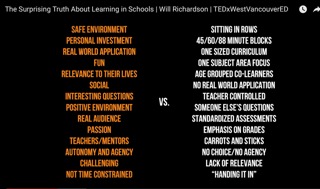
Want a little more? Here’s a slide I’ve used before. It comes from Will Richardson’s presentation at TEDxWestVancouverED. Look at the two columns and rate them as “truth” or “myth”.

Screen Shot 2016-04-09 at 4.07.32 PM.pngComing next… practical actions to move our practice from myths to truths.
Unknown's avatar

Where’s the Apostrophe When You Need It?

One of my favorite authors is Susan Scott. She’s written about the importance and process of having productive difficult conversations. Her works include Fierce Conversations and Fierce Leadership. I’ve used them in my coaching work and they provide an excellent approach to doing something that too many of us have had to approach with little or no formal training.

screen-shot-2016-10-14-at-2-15-29-pm

Commons@wikimedia.org


In one of her talks she recounts a conversation she had with her young, school age daughter who returned home from school and announced that she had had an apostrophe in school that day. Scott was confused and asked her, “An apostrophe?” Her daughter continued, “Yes, Mom, an apostrophe. You know…a new idea.” Aha, thought Scott, “an epiphany”.

As many of you know, I have focused a lot of my recent learning on the differences between having students (and adults) learn how to do school as opposed to how to focus on doing learning. I’d like to call your attention to a piece I read recently that might add additional depth/insight to this.

A recent post by Bruce Dixon in Modern Learners brought Scott’s story back into focus for me. Dixon begins his piece by calling attention to the issue of bells in school. He quickly moves to a much larger question. The issue of bells

…leads to broader issues around the structure of the school day, the structure of learning groups, and how the physical learning environment best serves those outcomes.

All of which begs the question, why do we do what we currently do in our schools? Are we doing the right things by our students, or just doing the wrong things right, because that’s the way we’ve always done it?

The answer isn’t bells or no bells, 40, 50 or 100 minute lessons, or mixed aged or segregated classes. The answer is found in our beliefs about how our students learn, and under what conditions they will learn most powerfully and deeply.

Dixon continues and refers to work by  Seymour Papert (“Why School Reform Is Impossible”)  in which he suggests (and this is the ‘apostrophe’ that has yet to reach critical mass):

“The structure of School is so deeply rooted that one reacts to deviations from it as one would to a grammatically deviant utterance: Both feel wrong on a level deeper than one’s ability to formulate reasons.”

Dixon extends Papert’s conclusions by adding …

“So the biggest and fattest myth is that the learning needs of our young modern learners today are well served by the traditional model of schooling.“

And here lies the apostrophe/epiphany. It is the realization that schooling does not equal learning and, in too many instances, it doesn’t even lead to learning… other than the learning about how to ”do” school. Schooling as designed and refined in its current form emerged in the late 19th century is not sufficient for the needs of our current time. But not only is it not sufficient, there is growing evidence to support the conclusion that it is impeding the response to such needs.

Aided and abetted by the questionable motives of some “school reformers”, we are witnessing an unprecedented decline in confidence in our public schools (and by extension our teachers). We are seeing the “selling” of charter schools, expanded choice options, and a rise in the home and unschooling movements.

Even the recent high profile competition organized and led by the widow of Steve Jobs, the XQ Superschool Initiative, which offered awards of $10 million to successful designers, focused on the re-creation of school.

Apparently, wealth and good intentions do not equate to apostrophes and epiphanies.

In a recent presentation for approximately 150 teachers and administrators , I asked the participants how many had learned something within the past month by going to YouTube.  I saw a sea of hands. I then asked how many had done this either during school hours or from within the school building. Three hands!

The apostrophe. This is no longer 1890. It is no longer 1990. Schooling is not learning. Schools as models and, perhaps, centers of learning will and should continue. Schooling with its focus on efficiency, convenience, compliance and standardization should not and cannot.

Dixon concludes

“Perhaps the truly biggest myth about school change is about its possibility. So little has been changed by so few, that many still find it hard to believe it’s even possible. Maybe we should start by busting some of the myths that endorse our existing model of school and create some truths that better reflect the realities of learning in our modern world.”

Where would you start? What Myths would you start to explore?

And so, the next post reveals itself…why is change so hard? Exploring Dixon’s assertion ”the biggest myth about school change s the possibility of change”… why is that? What are the implications?


Unknown's avatar

A Chance to Do the Right Thing


screen-shot-2016-09-29-at-3-16-05-pm

Flickr, Evan Shelhamer, Oct 17, 2013, CC some rights reserved

As a break from the overly lengthy posts of the last couple of weeks, I wanted to focus on just one idea this time.

Call me cynical, but when large corporations advertise that they are on the cusp of providing “personalized learning systems”  for students, accompanied by pictures of smiling children with headphones seated in front of a computer, my skepticism meter begins to beep.

Earlier this week I received a fascinating link from a good friend and colleague. The link was to a piece offered by a British publishing firm, Raconteur. (See About Us note below). It addressed the rapid increase in investor attention and development efforts in the areas of Artificial Intelligence for Education (AIE). The authors spoke to the accelerating progress in AI and the potential impact of advances on education.

As an example of this promise, the authors describe the variety of ways in which Artificial Intelligence can supplement and support the work of teachers as they work with students to improve content knowledge. The meter began to beep again.

For me, this highlights a basic problem – the authors of the article and most likely those working in the area of artificial intelligence are starting from the same misinformed perspective as the architects of the reform movement. They begin with the definition of education as the transmission and acquisition of content-based knowledge. This is much too narrow a starting point and leads to the equally narrow direction for solutions – solution to problems defined as the failure of schools to deliver to students the skills to reach the requisite levels of accomplishment.

In our Flipboard magazine, Career Readiness – Now and for the Future, we have curated numerous studies, surveys, and discussions regarding the need for the development of skills and dispositions that extend well beyond the acquisition of discrete content knowledge as currently documented through single large scale assessment regimes. This growing awareness further validates the importance of learning how to learn, how to be, and how to do as the cornerstones of learning experiences for our students.

While folks in higher education, business owners, and corporate leaders throughout the country are sharing the urgent need for what are commonly referred to as “soft skills” – i.e., things such as collaboration (real-time and virtual), social intelligence, critical and adaptive thinking, understand concepts across multiple disciplines, perseverance, tolerance, etc., state and national policy makers continue to focus on the results of large scale assessments in 2-3 discrete content areas.

Artificial Intelligence in Education initiatives that improve the effectiveness and efficiency of learning that which is increasingly being recognized as the wrong thing will simply add to the list of disappointments in our education, further fuel the misguided blame on our schools, and continue the commitment to trying to do the wrong thing better.

From Raconteur’s About Us page

Raconteur Media is a publishing house and content marketing agency. Raconteur produces special reports for The Times and The Sunday Times, as well as content marketing solutions for brands and bespoke market research. Raconteur combines premium editorial, analysis and graphic design with a commitment to high-quality executions in print and online across all of its services. Our content informs, inspires and influences thought leaders worldwide.

Don’t know about you, but I find the last sentence a little frightening.

Unknown's avatar

So Many Questions

borowitz-img_0291You may recall that a week or so ago, I took my own advice and offered testimony at a public hearing organized and hosted by the state Department of Education. This event was a part of a requirement for the state’s submission of a plan for the recently passed ESSA legislation.
As Ken Robinson pointed out in one of his TED Talks, the naming of such of pieces of legislation is a clear indication that at least the nation’s legislators have a well-developed sense of irony. In the face of leaving lots of kids behind after 15 years or so in the world according to NCLB, the marketing folks pulled out all the stops in the naming of the successor legislation… Every Student Succeeds Act. Irony rules again. I guess an act entitled “Too Few Kids Succeed” while likely accurate, lacked the necessary inspirational quality.

In my testimony I described the failure of solutions based on trying to do things right – like designing and implementing better, more rigorous standards, like the design and implementation of the consortia developed large-scale assessments – and urged the Department to spend more time on identifying the “right thing” before leaping once again into solutions destined to do the wrong thing better.

Although the testimony was well received (at least by the educators and parents in attendance, if not the officials and staff from the department), I felt lucky that no one asked me, “So what is the right thing.”

So here I am, halfway through exploring the answers to the question that wasn’t asked and realizing that I’m committing myself to yet another testimony, this one more detailed and to be offered during the public testimony segment of the state board of education’s public meeting.

While working this process, I realize I needed to move beyond the “homily” approach and ask for your help. This piece offers neither advice nor specific answers. Instead I want to try something different and explore collaboratively what kind of commonality in thinking exists around the what is the “right thing” to do question as we try to match learning experiences with the needs of our students and our society. I’d like to ‘crowd source’ this and invite you to share your reactions, reflections, and/or experiences so that these can inform the development of my next testimony. Any time you can spare to jot down a few things would be extremely helpful.

Here’s what I believe I know about this.

First… Where are we?

  • We have confused ‘schooling’ with education/learning.
  • This has encouraged students (and many of their teachers) to learn how to “do school” as contrasted with learning how to “do learning”.
  • As educators we’ve grown up in this system and it is what we know.
  • The majority of us functioned well in this system and have felt comfortable returning to it as we acted on our vocational interest in helping children.
  • As such, we represent both the greatest strength of the system and the biggest obstacle to changing it.
  • While there have been encouraging examples of innovative, purpose-driven programs, the vast majority of “innovations” have succumbed to the temptation of simply doing school better. – i.e., if school as we have come to know and experience is the wrong thing, they have succumbed to trying to do the wrong thing “righter”.   Preliminary studies reveal that the majority of such “alternative” programs/schools rarely perform at levels beyond their traditional public school peers.

Second, what I believe is the “wrong thing”…

  • At a very deep level, an increasing number of educators are concluding that we are doing the wrong thing – that not only have the past 30+ years of standards, assessment, accountability-based solutions not had the desired impact on student achievement, but also the cost in student (and teacher) engagement, the lost opportunities for creative explorations, and the mindless standardization of experiences which ignores the differences in children in the quest for efficiency and ease of measurement cannot be allowed to continue. This is wrong!
  • We are focusing our attention on the wrong argument. This is not about standards vs. no standards nor can it be framed in terms of large-scale assessments vs. no assessments. Of course we should have high standards. As Ken Robinson asks, “who would actually argue for lower” And certainly we need to assess both ourselves and our students. What we don’t need is to narrow the focus of what should be learned to a couple of core content areas, using single measures to judge such learning, and punishing schools for the accident of being located in centers of poverty. This is wrong!
  • This about ignoring what we know about human differences, about learning, and about engagement in pursuit of ideologically driven, market-based “solutions” to problems that we have allowed others to define for us (and, in so doing, ceded the authority to them for the solutions). This is wrong!

Third, what is the “right thing”?

As a nation, we have grappled with the purpose and reach of education throughout our entire history. While many of the reforms introduced into our system of public education in the 1800’s and early 1900’s were the result of committees and commissions whose membership was drawn largely from academia, the direction of our recent reforms has been dominated by politicians and business leaders. The resulting direction focusing on market driven solutions, assembly line schooling and attacks on teacher unions should come as no surprise.

For me, Clark Aldrich, in his book Unschooling Rules:55 Ways to Unlearn What We Know About Schools and Rediscover Education, comes closest. He suggests that there are really three kinds of learning that should serve as the focus for education and as the basis for the learning experiences we design for our children. We need to be intentional about helping our children:

  • Move beyond the focus on what and focus on how to learn – learning doesn’t stop with the exit from school. Now, more than ever before in our history, both the access and the need determine that learning will be a life long activity.
  • Emerging focus on the importance of life/career dispositions and skills is in response to experiences which are demonstrating that such dispositions are at least as important to the success of students in higher education and employment as subject matter content knowledge. Aldrich suggests this is a form of learning how to be in relationship to others and the world around us.
  • George Couros in his blog suggests that it is not the knowing that matters. Rather it is what we can do with this knowledge that is critical. Learning is intimately connected to creating and doing. Without this connection, the facts that we learn are quickly converted to fleeting memories. Aldrich notes that this third type of learning is learning how to do.

Perhaps, Aldrich’s thinking is overly simplistic. Perhaps you believe that the purpose of education should be broader, more inclusive, more specific, Regardless, I believe there are questions that we should be considering – essential questions whose answers do not fit well inside of the continuation of focusing on the wrong thing. I‘ve included several as starting points for reflection and possible comment.

What should discussions of the “right thing” explore?

  • There is no other facet of our lives in 2016 where learning is so tightly defined, so restricted to geography – i.e., the location (and related level of poverty/affluence) of our district and our school – and so closely associated with the work completed inside a building. How can we broaden the options for Why do we continue to limit “what counts” as learning beyond the learning that takes place in the school?

How can we move beyond our outdated understandings about how we and young people learn? Take a look at Will Richarson’s graphic comparing how we organize learning in schools (right side) with what we know about learning (left side). This slide comes from Richardson’s TEDx presentation in Vancouver.

Richardson conditions

How can we modify the organizational patterns and structures of school to facilitate the incorporation of Richardson’s ‘truths” about learning?

  • Faced with growing evidence of the causal relationship between social-emotion skill/disposition development and success both in and beyond school, how can we move beyond the reliance on a single test score as the major factor in our judgments about students, schools, and teachers? How can we gather and report meaningful information about the state of development of these critical skills and dispositions in our students?

I hope you’ll join me as I continue to explore the ways in which we can work together to broaden the understanding of the importance of focusing learning experiences on the right thing and bring an end to the continuation of doing the wrong thing better.