Unknown's avatar

Culture Trumps Strategy – And Almost Everything Else

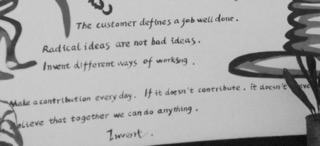
culture-pic-screen-shot-2016-09-13-at-7-16-49-pm

Shared from Flickr – CC, Photo by Bo Gao, April 2006

For the past 10 years or so I’ve been working with schools and districts around the country on ways to improve student performance. For most of that time I had the privilege of working with Bill Daggett’s company, the International Center for Leadership and Education. (ICLE). This opportunity brought me into contact with many talented and dedicated people, both at the International Center and in the schools and districts that I had the opportunity to support. One of these people was Ray McNulty. Ray always seemed to capture not only the minds, but also the hearts of the folks with whom he was working.

At one of his presentation, I was reminded of an old TV commercial for an insurance company, where after a grand and flowery introduction extolling the wisdom that the audience would be privileged to receive, the speaker moves to the podium, says the word “Wausau” and walks off. In Ray’s presentation, he did not repeat the ‘Wausau’ moment. But he came close. He walked on stage in front of several thousand people and said, “Culture trumps strategy.”

This past week brought two reminders of the importance of Ray’s statement.   The first of these came when I read a blog post from Mark Weston (it’s a great read). He spoke of a recent hiking experience where part way through a challenging trek, he was beset with doubts about his ability to complete the trip. In his words, “ Scared, depleted, no energy to spare, little hope, I seek comfort on a rock. Sitting there, I drink water. Eat four fig bars. Rub my forehead. As I do, doubt keeps me company.”

While  there on his rock, exhausted, sore, and dispirited, he heard other hikers on the return trip from his destination. One of he hikers looked at him, smiled and offered, “Nice day to hike.” He challenged himself… if they could do it, so could he. Mark continues on… “From this point on, every hiker I encounter along the final stretch of the trail gets a smile, nod, or kind word—sometimes, all three—from me. I have learned the lesson of this trail. I now see that each gesture, however small, is a conveyance of hope, an antidote to doubt, a soulful balm….”

This past weekend I had the opportunity to attend a ceremony honoring the memory of a highly respected and loved superintendent who was tragically killed. He was an inspired and inspirational leader. The ceremony was attended by people from throughout the community. It was a beautiful a testament to the culture of respect and collaboration that he had worked so hard to develop. His former assistant superintendent, now serving in his role, offered the following:

We are gathered here for one single reason — LOVE.

Now hearing this four-letter word can make many of us feel uncomfortable.  Although we tend to use this word casually — I love chocolate chip ice cream, I love the Mets… we don’t always know how to say it and use it in the way that we actually live it with our words, actions, and deeds.

Yet over a thousand of us are here because of one man’s love –

  • His fierce love for his family
  • His love for his friends and his faith.
  • His advocacy and love for each student under his care and our  work as educators
  • His love and steadfast commitment to his community
  • And his vibrant love for life.  

 Boy, did he love life!

Steve taught us that when you see each person and the world with eyes of love, you create opportunities for hope and develop an appreciation for our human connectedness.

This kind of love lifts us so we become our best selves and are able to imagine a world of limitless possibility and potential.

This is not easy.

It takes a conscious effort to live a life of love.

But look how one man’s love compelled all of us to come together at school, in the community, and here today. The love he gave out has been returned exponentially.

 Just imagine the power of the collective love of all of us — the way we could transform the world.

For the past 5 years or so, my focus on working with school leaders has been about the notion of culture and the importance of building trust. This is not an easy sell. There are lots of “I/we won’t” statements masquerading as ”I/we can’t” statements.

Cultures take time, sometimes years, to develop. They develop bit by bit. They are not undone overnight. For a school leader, the path is filled with struggles, obstacles, self-doubt. We ask, “Can it really happen? Can I really do it?” By himself, Mark might not have finished the hike. But he discovered he wasn’t alone. In the stillness of his time sitting on the rock and fighting self-doubt, there came an answer.

I learned that Steve would frequently end a short conversation with staff members, students, and his own children with the phrase, “Make someone’s day today.” He did. Kathie’s remarks reveal that they did. You can too.

It’s where culture shift begins.



Unknown's avatar

Blame Helps No One


blame-wendy-wyatt-st-thomas-university

Shared from Wendy Wyatt, University of St. Thomas

I don’t know if you’ve noticed but one of the first questions asked after any kind of unpleasant event is “Whose fault was it?”


On one level, such questions serve a very useful purpose – they keep us from having to explore the possibility that we may have to own what went wrong. Identifying someone by name, even better, being sable to display a picture of the responsible person, offers us a sense of order, sense of justice, and, even, a sense of security.

With the release of A Nation At Risk in 1983, we identified not only the problem (poor academic achievement), but also the culprit – the American school system.

We had completed a test-drive of this thinking immediately following the Soviet launch of Sputnik in 1957. We were told that the blame rested squarely on the shoulders of our schools for not producing a sufficient number of scientists and world language teachers. No one need look deeper for other, perhaps more salient reasons. We were told who was responsible and we accepted it. We had our villain.

Now, with A Nation at Risk, we not only solidified our belief in the failure of our system but we also blindly accepted the recommended solutions. No need to look further. Our schools were too soft. We needed more rigor. We needed more time in academic subjects. We needed better schools.

Twenty years later, our schools were still not rigorous enough, our students not still accomplished enough, our test scores still not good enough. We needed better standards. We needed better assessments. We needed accountability. We needed a new scapegoat. If the schools still weren’t good enough, there must be someone to blame. Ah, but wait a minute! If our schools, even after twenty years of improving standards and tests, still weren’t good enough, who was to blame? Well, of course, it was the teachers. They were the problem. They weren’t good enough. We’ll make sure ”no child is left behind” by insuring that all teachers are “highly qualified”.

There you go. All is now right with the world. We’ve found the culprit. We don’t have to look at the data. We can ignore that kids in wealthier suburban districts were doing well and that kids in poverty were not. It’s the teachers. We can bring “better” people into the profession through programs such as Teach for America. That’ll do it. But wait, it didn’t. With very few exceptions, poor kids in largely falling down and under-resourced schools continued to reflect the problems of generational poverty and the struggles of life in the inner cities.

So let’s consider this. Perhaps it is the teachers. Perhaps it is the teachers doing precisely what we’ve trained them to do – and what we trained them to do that was geared to a level of expectation before the arrival of A Nation At Risk, before the 24/7 access to the stuff we had been charged with pouring into their heads, before the revolution of social media – before teachers were called upon to do things that they had never been trained to do and which run counter to their experiences as students themselves.

If it is the teachers, let me share that is not because of lack of caring or commitment – the kind of caring and commitment that I have seen over and ever again in the more that 50 schools and districts I have observed in the last decade. It is precisely the caring, the commitment and the devotion that prompted one young lady I interviewed to tell me, “The teachers at this school are annoying. They won’t let me fail.”

I believe that it is the teachers but, most importantly, it is the culture we’ve deliberately created in our schools. It is a culture that prizes compliance and efficiency over learning. It is a culture that focuses attention on a limited number of academic subjects, too frequently at the expense of the very things that we hope to engender in our students. It’s a culture that does this far too frequently at the expense of the time they desperately need to discover and explore their passions. It is culture that seriously shortchanges the need to help students learn how to be in a world that is becoming increasingly foreign to the adults charged with helping them find their way.

The road to moving beyond the “blame game” is one where:

  • We focus on defining what we really want for our kids under the notion of life, college and career readiness
  • We define in concrete terms what this phrase, “life, college and career ready”, means.
  • We engage our teachers in deep conversations about what they need to learn in order to successfully cause this to occur with the student they see.
  • We commit to the delivery of experiences for our teachers that allow them to be successful in this mission.
  • We define leadership positions in the context of commitment and capacity to redefine teaching and facilitate the successful development of the tens of thousands of caring and committed teachers who have been unfairly called “the problem.”

It is road on which we bring increased intentionality to the role of teacher and school leader – an intentionality defined by causing learning. It is a road where we provide for teaches the clarity of purpose, the autonomy and the opportunities for mastery that Dan Pink suggests in his work on Motivation.


It is a road that defines our schools as centers of learning – centers that design engaging learning experiences for our students and ourselves, centers that can facilitate and collate the learning of students wherever it occurs. It is road on which these places are staffed with the dedicated, caring, and supportive people that a have always defined the best of the teaching profession.

Unknown's avatar

Writing as a Look in the Mirror – The Testimony Journey


kitten_and_partial_reflection_in_mirror

Shared from commons.wikimedia.org

One of the real dangers of writing a blog surfaced for me this past week. Inspired by Jan Resseger’s blog that urged readers to action in reaction to an upcoming series of mandated hearings regarding the implementation of the new federal successor (ESSA) to NCLB and Race to the Top, I added my voice in support of the value of social activism. After pressing the “publish” button, it dawned on me that I was also speaking to myself.

I decided then that there would be at least one person who would respond to my challenge – me. I realized that I needed to testify in order to do more than simply pay lip service to a deeply important issue.

So here I was challenging others (and myself) to participate in a process that I had only seen from the other side – as the organizer of such testimony sessions or as the state’s representative at them.

My experience with this process wasn’t positive. Testimonies were recorded, questions were referred to the proper program officer, answers were crafted and attached to the record. Rarely did anything change. Those who provided testimony, either in support of or in opposition to the proposals under review rarely had the opportunity to address the department’s responses. But, from the department’s perspective the process had been completed, the boxes had been checked, the requirements fulfilled and life went on.

I was reminded of this process at a dinner with a close friend and former colleague whom I had told of my testimony plans. He shared with me the testimony he had provided in 2008 about the folly of continuing to invest in the standards/assessment solution in the face of what had been accepted as disappointing student achievement. He also shared with me a letter I had written (several years after having left the DoE) in support of his position.

The impact of that effort? Here it is 2016, we have more data to support the position that the direction of the so-called reform movement has been a failure. We have witnessed a pretty sizable rebellion by parents against PARCC. We are watching the federally supported challenges to our public schools through the support of privatized charter schools and we are still discussing where the deck chairs should be placed on the Titanic.

So why bother? How can we not? Perhaps getting the data, our position, and the harm this is doing to the very kids that we want to help the most is the first step in adding professional voices to those of parents who have seen the damage firsthand. Perhaps this is time to apply the lessons learned from previous ineffectiveness of the public testimony process and to acknowledge that this is a necessary FIRST step in a more aggressive strategy. Perhaps we have seen and experienced enough. And if not us, who?

Perhaps you would like to share your own activism experiences both to encourage others and to expand our exposure to best practices.

Upcoming blog topics:

  • Well, how did it go – a summary of the my experience on the other side of the podium
  • Let’s stop blaming teachers – they’re only doing what they’ve been taught to do.


Unknown's avatar

An Alliance-based response to Bandwagons and Train wrecks

Bandwagon 2016-08-26 at 2.23.29 PM

Shared from blog.hoosiertimes.com

Let me begin with two disclaimers.

  • I am angry. I am angry that so many of the people that I have worked with and whom I have seen in my visits to schools around the country are having their work and commitment demeaned and depreciated. But I’ve learned that anger is secondary emotion and there is a root cause for that anger. For me it is frustration. I am frustrated with our nation’s continued unwillingness to devote sufficient time to the analysis of a problem, pouring incredible resources to the wrong thing and then seeking scapegoats when the solutions (to the wrong problem) are unsuccessful;
  • I am not a social activist. I’m not a political organizer. My only attempts at such activity involved trying to organize the teachers at the private school where I began my teaching career. I was invited to look elsewhere for employment. I’m looking to have a better end this time around.

So this post is a follow-up to the recent” what can I do” blog. It is not a cookbook on political organizing. It’s about changing roles. It’s about changing roles because I believe that our ability and willingness to effectively organize and affect our futures are directly related to the role that we see for ourselves.

As teachers we have experienced a unique form of career exploration and training. We are most likely the only profession in which the practitioners had at least 16 years to observe the career that they eventually selected. What is remarkable about this is that, while much is written about the quality of teacher preparation programs, the impact of postgraduate studies, and the value of locally offered professional development, substantial research exists that indicates that these have not been the determining factors in how teachers teach and how they see themselves.

The most formative factor turns out to be how they were taught. That is to say that we have been trained not only in how we teach but also how to see ourselves by the experiences we have had as students in school and our observations about how teachers behaved and saw themselves.

The point here is that the vast majority of teachers have formed their notions about teaching from experiences that they had at least 10-20 years before they entered the profession.   As Kieran Egan expressed in his book, The Educated Mind – How Cognitive Tools Shape Our Understanding, these lessons were learned during a time when one of the primary goals of the American education system was the homogenization of our society – the intentional efforts to protect and transmit the societal norms of the time.

The success of this mission was measured by behavior and the compliance with the established norms. We have both been trained in and charged with insuring compliance. It has become an accepted part of the DNA of teachers in our country.

The world has changed (you may have read something about this); however, we have maintained the roles and role expectations that were formed in another time and in a different context. That is to say, our default response when confronted with confusing and often uncomfortable data is… compliance.

Since the publication of A Nation At Risk in 1983 the citizens of our country have been fed a steady narrative of failure. During that same time we have witnessed the ideological commitment to this narrative and a series of “reforms” designed by such great educational thinkers as the National Governors” Association and funded by an increasing number of “education-minded” philanthropists.

NOTE: For an interesting and contrary analysis of the scholarship behind A Nation At Risk, you might like to read an article that appeared in EdWeek in August 2004, 20 years after the reports publication.

While in our faculty rooms and at teacher dominated social gatherings, you might hear frustration and anger at the unfairness of the current anti-school/anti-teacher narrative. As individuals, however, we have remained largely silent as the standards/assessments, test/punish direction of mandated programming continues and expands.

So?

Egyptian Revolution  2016-08-26 at 2.54.40 PM

From Facebook

I believe it is critical that we cast off the role of quiet compliance. I believe it is time for us to recover the leadership of the direction of what happens to our kids in our schools. It is no longer enough to assume that paying our association dues and nodding our heads to the lobbying efforts of our national organizations will derail (or for the optimists, redirect) the direction of the last two decades.

So What Can I Do?

We old folks can remember a film from 1967, The Graduate. The film contained a memorable moment when Dustin Hoffman received a one-word piece of advice for his career choice and future – “Plastics”. After a seemingly endless pause, the advice giver explained that there was a great future in plastics.

The 2016 version of that one-word piece of advice for us is – “alliances”.

I included above a photo from the Egyptian Revolution of 2011. I included this to remind us of the manner in which a grass roots movement exploited 21st Century communications tools, like Twitter and Facebook, to inform, to encourage, to mobilize and, yes, to coordinate the efforts to raise awareness and force change.

One of the ironies and untapped strengths of our situation is that, while the politicians and business leaders have committed huge amounts of resources to demeaning teachers and teaching, to the narrative of schools as “failure factories”, to the “wonders” of portfolio school systems (read privatized), the majority of Americans surveyed continue to trust the teachers of their children.

We need to build alliances on this trust and help these alliances change the narrative of public education and teaching. We need to begin with the parents in our classrooms. We need to bring information to them, in easy to digest format – blogs, video clip, infographics, etc.

As I mentioned in the first post on this topic, Jan Ressger’s report  on the efforts of the folks in Vermont gives us great talking points to begin our conversation. Diane Ravitch and Sir Ken Robinson add wonderful insight and direction as well.

We need to bring this same information to local and regional PTA/PTO’s.

We need to highlight and emphasize the real consequences that our kids are experiencing in this reform age.

As threatened as we might be by the unfairness and lack of validity of test-based teacher evaluations, we need to separate that issue from the harm done to our children by the test score driven, one-dimension measurement of kid success and the accompanying loss if attention to the development of multiple talents.

We need to help interested parents prepare to talk with board members about planned or real reductions in arts programming, flack of focus on life/soft skill development, one-size fits all curricula, etc.

But most importantly we need to learn from the organizing lessons of the Egyptian Revolution, Occupy Wallstreet, and, most recently, the Opt Out movement to leverage social media potential into an intentional effort to prevent the continued chasing of the wrong thing.

We need to step away from the traditional role of teachers – a role that emphasized isolation and independence – to one that utilizes the demonstrated strength of alliances. We need to form alliances with colleagues both in our schools and via social media in other schools. We need to form alliances with parents to help them make their voices heard. We need to form alliances with members of our local boards of education and to help them form similar alliances with their counterparts in other districts.

A final disclaimer. This is not about the preservation of the status quo. This is about eliminating the distraction caused by a thoughtless and ill-considered reform agendas that focus on moving backwards into the future. This is about gaining the opportunity to re-imagine education, learning, and the place of our schools in that process.

If you would like to continue this conversation about concrete actions and alliance building opportunities, please add your voice to the comments.

Unknown's avatar

What Can I Do?


A while back when I started this blog I felt there were some things to say that didn’t seem to be getting much attention. Additionally, I found that writing helped me organize and clarify some of the jumbled thoughts and feelings that I’ve been having about the direction of education, as well as the ways I had been responding to that direction. An additional benefit was that, in doing research for the pieces that I’ve published here, I’ve found a number of exceptional voices trying to shine a light on what has become an increasingly politicized, monetized, and privatized national agenda.

If you have found some resonance with the thinking I’ve shared here in this blog, I urge you to subscribe to the blogs of Jan Resseger  and Will Richardson. I continue to be inspired by the thoroughness of their work and the quality of their thinking. Today’s piece is inspired by recent posts by both of these insightful and articulate voices.


History Book

Courtesy of historyforkids.net

I’m sure that many of you recall a line from the introduction to your history textbooks and exhortations from teachers that went something like…“We study history so that we may learn from the mistakes of the past and avoid repeating them in the future”.

I hated that thought as a student and didn’t like it much more as a teacher. I reasoned that the mistakes of the past were made by men far more powerful than I and it was unlikely that I was ever going to be in a position important enough to have the chance to avoid repeating them. But life experiences have a way of intruding on our earlier explanations. While facilitating retreats for teenagers and adults. I recall hearing the saying attributed to Native Americans…”Some people are born blind and die drunk.” It was a call to develop the habit of self reflection for it was only through this introspection that we might grow in awareness and avoid a “drunken” death. Part of my own self-reflections brought me back to that history quote.

And the connection is?

For me the connection is that my assessment of my own power to learn from the mistakes of the past and to avoid them in the future was seriously flawed. It was not only the mistakes of the rich and powerful that shaped history. It was also the silence of others. The silence of others throughout history is understandable. It was/is frequently related to the busyness of survival, the energy required to do one’s job and just stay alive. Not infrequently it was/is also related to fear – fear of reprisals, fear for one’s job, fear of being different.

We are where we are today in our chosen vocation because we have been too silent. Regardless of the attempts of some “reformers” to call into question your commitment, dedication and skill, you have chosen a noble profession. You have worked diligently and tirelessly. I have seen this commitment, dedication, and skill in schools I have visited throughout the country. You have tried your best to do better the things you learned and were taught about helping young people. You have been diligent and, often, courageous. But you have left the direction of the education of our young people to others. Others who have more time, more money, and an inflexible belief system.

In one of my next posts I will write more about Will Richrdson’s recent piece  on the distinction between the words “I can’t” vs. “I won’t”. But, for now, just consider this possibility. Too frequently, we have used the words “I can’t” as a response to calls for change or even to our own inner voices calling for such change… I can’t focus on soft skills, I have to prepare my kids for PARCC. I can’t alter the curriculum, the state department has mandated what I teach. I can’t eliminate grades, the local school board, principal, superintendent won’t allow it. I can’t champion a kid’s right to get credit for things learned outside of school, etc. etc., etc.

Richardson asks us to consider the likelihood that what we are really saying in such situations is “I won’t” focus on soft skills. I won’t change the mandated curriculum. I won’t speak at the local meeting of the board of education to support less testing. I won’t help kids get credit for learning that happens outside of school, etc. I’m too comfortable, I’m too stressed. I’m too busy. I’m too fearful…

Until we change “I won’t” to “I can and I will” we, too, will prove the validity of that rationale for the learning of history in the intro of the history textbooks. We will continue to condemn ourselves to repeat what we believe to be wrong.

In her recent post, Jan Resseger provides a concrete step to help us move beyond the mistakes of the recent past. She notes that most states will now be holding hearings on the implementation of the new ESSA legislation. She challenges teachers, school leaders, and parents not to rely on their state organizations to make the case for change.

The Every Student Succeeds Act (ESSA) demands that states come up with their own accountability plans which they must submit for approval to the U.S. Department of Education. What this means is that there is a window for change, but it must bubble up spontaneously across the 50 states. If public school supporters are to achieve any kind of policy that is more supportive and less punitive, we are going to have to organize and begin working for long-term change in the culture of punitive, test-and-punish accountability that has been normalized over the past two decades.

It is time for those of us who recognize that the current reform movement is creating the wrong future for education in our country to act. We may not be as eloquent as Resseger or Richardson but this doesn’t make our voices any less important. It is precisely our voices, one by one, and joining collectively in concert,   that can stop the repetition of past mistakes and help avoid continuing them into the future.

Make your voice heard. Check your state department of education’s website for information about the dates for scheduled testimony.

Unknown's avatar

A first step in moving beyond belief-based school reform


aug 14 -1 IMG_1150

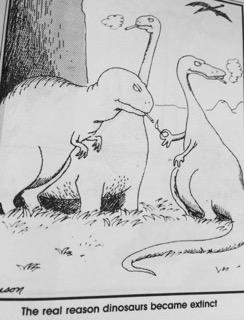
The Far Side Gallery – Gary Larson

Climate Change Thinking as model for education improvement 

 NOTE: This is an updated version of a piece that appeared earlier this year in  NJ Spotlight and is inspired by a recent post by Jan Resseger that reported on a newly released book of research dealing with data and studies that reveal the failure of the last two decades of “school reform”. 

I’m sure I’m not the only one who noticed that,  during the primary season, a number of the candidates raised the issue of climate change to new heights (or depths) of absurdity.

Look at this…

In 2013 the American Association for the Advancement of Science released a report on climate change. Now keep in mind that this non-profit organization, founded in 1848, is currently the largest such organization in the world and is hardly a hotbed of liberal, progressive thinking. According to the report, only 42% of American adults understood that “most scientists think global warming is happening” and 33% said, “… there is a lot of disagreement among scientists about whether or not global warming is happening.” Twenty percent said they “don’t know enough to say.”

The report continues with the fact that polls continue to show that there is a belief that scientists are not in agreement about climate change and its cause. At the same, the AAAS reports that in 2014 about 97% of climate scientists conclude that humans are changing the climate.

They conclude – An increasing number of folks are telling us that we run the risk of significant irreversible damage to our planet because we would rather continue to act on our beliefs rather than confront the possibility that science has revealed that we have been in error.

So here’s the connection to education reform.   In the arena of public education, we are engaged in a battle of belief vs science. But much like the climate issue, we are seeing an increase in the number of folks who are calling attention to the nakedness of the belief system that has ruled the direction of education and schooling in our country for the past several decades.

This is being greatly aided by the work of the authors of the volume that Jan highlights in her post. As she points out in her blog “If you were to undertake a research paper on the impact of No Child Left Behind and Race to the Top here collected in this new volume is much of the scholarship you need”. She continues…

This volume presents a comprehensive collection of the most rigorous research evidence about both the test-based reforms reforms and policies that have become the new normal, and the less common, most promising strategies for the future… “In its entirety the scholarship in this volume points overwhelmingly to one unambiguous conclusion – heavy-handed accountability policies do not produce the kinds of schools envisioned under the original ESDA…” (Emphasis mine… see above referenced link, pages  xix-xx)

In my original piece, I referenced the work of Russell Ackoff and an interview conducted with him before his death in 2009. Ackoff was a new name for me. A little research revealed that he had a long, varied and distinguished career, including a time from 1986 until his death as professor emeritus of the Wharton School at the University of Pennsylvania.

In Ackoff’s interview he noted that, while we frequently used the terms synonymously, there was a growing recognition that there is a difference between efficiency and effectiveness and that Peter Drucker had captured this by saying that there’s a difference between ‘doing things right’ and doing ‘the right thing’.

Ackoff expands by suggesting that doing things right is about efficiency but doing the right thing is about effectiveness. He makes a strong case for the connection between wisdom and doing/identifying the right things. He notes further that when we try to do things right about the wrong thing, we actually make things worse… such attempts at improvement actually take us further from both the recognition and accomplishment of the “right thing”.

So here it is. How long can we continue to deny the obvious?

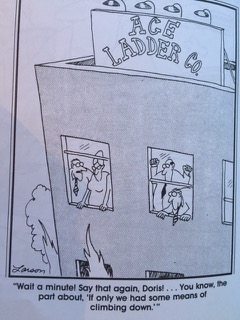
Ace Ladder Aug 14 - 2

The Far Side Gallery – Gary Larson

I have spoken with hundreds of educators throughout the country who , while working hard to implement the “reforms” based on ever more rigorous standards and ever more extensive (and expensive) assessments, recognize the folly of the direction.

It is time for those of us who have read the science and have lived the misguided attempts to do the wrong thing better to speak up. Not because we are concerned about the ways in which such reforms and the attendant emphasis on accountability threaten us, but because they threaten the future of our kids, take us further away from the goal of learning, and distract us  from the exploration of new structures and experiences for kids (and adults) that demonstrate our commitment to the ideal that minds matter.

In my next blog I’ll be exploring the ways in which we, the people who have the most regular and potentially meaningful contact with students in our schools, can take action. For now though the issue seems to be, on a personal and individual basis, “Can I continue to allow the risk of irreversible damage to our children because some ideologically and politically motivated people would rather continue to act on a belief system that has been demonstrated to be both wrong and harmful?”

Please share your thoughts and reflections.

Unknown's avatar

Apostrophes and Epiphanies

In her works on Fierce Conversations and Fierce Leadership, Susan Scott recounts her young daughter’s excited reaction to an “epiphany” moment by telling her mom that she just had an “apostrophe”. Here’s one of mine.

epiphany

A few weeks ago I promised myself that I would spend some time thinking about and exploring some key questions concerning the status and direction of education and learning in our country. It’s not that I pretend to have a great handle on where we are as a nation; however, in my travels to schools around the country, I noted that each school is engaged in some kind of journey that involves defining where they are and how to get somewhere.

In my morning reading regime, I came across a post by Jimmy Casas, entitled, ”Wherever You’re Going, You’re Almost There”. The author was describing a conversation that he had with a new assistant principal who asked him, “When did you know that you had finally gotten there?” The author shared that he had responded, “I’m not exactly sure. I guess that would depend on where I am headed and I haven’t quite figured that out.”

He went on to make the point “…that no matter how many years we serve in the role of school leader, we will never ever ‘get there’.”

But I had stopped processing at “I haven’t quite figured that out yet?” It was my “ah ha”, my “apostrophe”… we don’t really know where “there” is. Not for lack of folks trying to tell us. Way back in 1997 Kieran Egan summarized what he saw as the three major imperatives of our education system:

Note:  This is a book length pdf file.  If inclined to check it out, the first 5-8 pages should get you the idea.  More required an adult beverage to two for me.

  • We should socialize and acculturate our children – i.e., shape the young to the current norms and conventions of adult society;
  • We should teach them the knowledge that will ensure that their thinking conforms to what is real and true about the world.
  • We should encourage the development of each student’s individual potential.
  • And most recently, the National Governors’ Association and the Council of Chief State School Officers (with some philanthropic assistance) told us we should make kids “college and career ready”.

A quick review of these various “goals” for education in America reveals (a) that there is inherent difficulty in simultaneously achieving goals which, as Egan points out, are inherently incompatible and (b) that our schools and their mission statements faithfully reflect the acceptance of these imperatives regardless of these incompatibilities.

So what does this mean? For me it means that, given the wide variety of potential “destinations” it’s hard to be wrong… or right – wherever you are going, you can be almost there. And that’s where we are – almost there or not. Almost college and career ready, or not. Almost socialized to the norms and conventions of the country, or not. Almost reaching our individual potentials, or not. Almost certain that our students knowledge of the world is real or true, or not.

I realize that what was most outstanding about the exceptional schools that I visited was that they – the students, the parents, the school/district leaders, and the teachers were all clear about where they were going. And because they knew that, they were also able to assess where they were on that journey – and look at initiatives and strategies in the context of that destination.

compassI recall reading an observation by Steven Covey that we have gotten much better at the management of our clocks and calendars while spending far too little time on checking our compasses. I’ve seen Covey’s observation in action. The healthiest and most highly functioning places I’ve seen pay very special attention to identifying their compass heading, to assessing their progress and making course corrections.


For reflection

  • How intentional is your school, district, classroom about having a clear compass heading?
  • Who set/sets the course for the school?
  • How do you check to see if you’re on course?
  • Have any “apostrophes” you’d like to share?


Unknown's avatar

Home, Home on the Range (School)

The second in a series exploring where we are, how we got there and what we can do next.

Some time ago in my work conducting site visits, needs assessments, and case studies, I

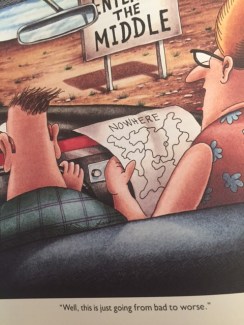
middle of nowhere_1129

                                   Gary Larson

had the opportunity to visit an exceptionally large school district in Nevada.

What do I mean by “large”? The district (a county district) was slightly more than 17,000 square miles, making it the 4th largest geographic district in the contiguous 48 states. I crossed a time zone to travel between schools. It was large.

In addition to the schools (22 of them) located in the county’s population centers, there were also a small number of rural or “range” schools. These were almost exclusively one-room schools serving kids in grades K-8. The smallest had a population of 3!

What did I learn there that might apply to places that, on the surface, seem nothing like Elko? I learned that their rural/range schools were not all that unique. Huh? Yup, that’s right. They were staffed by caring, hard working teachers (usually one). Teachers who looked at the kids and determined what they needed. Teachers (like the vast majority teachers I’ve met all around the country) who worked harder than heck to follow district curricula and, at the same time, give the kids what he/she determined they needed. They had minimal formal connection to the “big picture” of the district. They had minimal connection to their peers in other classrooms throughout the district.

When I visited other, more familiar schools throughout the country, I recognized that they were, too frequently, a collection of “range” classrooms. Classrooms where teachers tried to provide the best for the kids they had in their room (or class). Classrooms where teachers work incredibly hard and mostly in the same isolation that the teachers in Elko’s one room school houses did. Sure they have folks around them, but collaboration remains a rarity. As a friend once shared, our schools are most often a collection of classrooms connected by a common parking lot. People in them continue to do school much like we have been “doing school” since the early 1900’s.

So jump back now to one of our original questions… How did we get to where we are in our education system? We got to, and are continuing to get to, exactly where we are designed to get to.

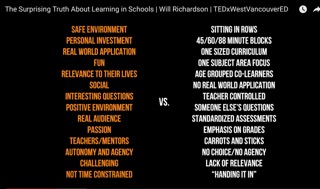
Take a look at a slide shared by Will Richardson in a TED Talk he offered in Vancouver, BC.

Richardson conditions


On the left are qualities many people list when describing meaningful learning experiences. On the right is a list of things done in schools. (Will Richardson)


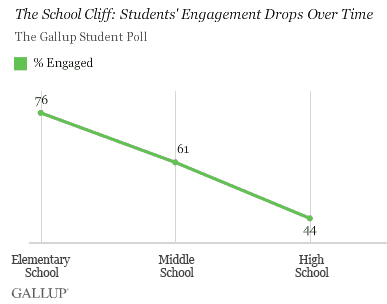
What is disconcerting is that at the same time we are continuing to do the things on the right of Richardson’s chart, we are seeing a startling decline in the level of student engagement in our schools. The following graph accompanied an article, published in 2013, on there Gallup site.

fwbrfu4vduqvib4hrqifeg

                 Brandon Busteed- January 2013


In his book, Why School: How Education Must Change When Learning and Information Are Everywhere, Richardson offers the following:

“What doesn’t work any longer is our education system’s stubborn focus on delivering a curriculum that’s growing increasingly irrelevant to today’s kids, the outmoded standardized assessments we use in an attempt to measure our success, and the command-and-control thinking that is wielded over the entire process. All of that must be rethought.”

So, how did we get here?  Seems kind of clear.  While education must change, it hasn’t.  Whether in the one room range school or in the the largest of our traditional schools, whether it’s 1940 or 1990 or 1016, we continue to work in a structure that almost demands that the teachers persist in curating what it is that kids should learn, how they should learn it, and how it should be measured.

One might actually ask the “how did we get here?” question a bit differently – How can we not expect to get ‘here’ – i.e., get more of what we’ve been getting – if we continue to do more of what we’ve always done?

As always, I’d love to see your thoughts on this…

  • What can we, as educators, do to reverse the slope of the Gallup findings?
  • How frequently do you see the strategies listed in Richardson’s  left-hand column used in your school/classroom?
  •  What can we do to move more of our kids’  learning experiences to the left column of his list?
Unknown's avatar

Unlearning: The Forgotten Skill for the 21st Century

I

disaster business IMG_1132

Gary Larson

In his great little book, Unschooling Rules: 55 Ways to Unlearn What We Know About School and Rediscover Education, Clark Aldrich suggests that the purpose of education today is threefold: Help kids learn how to learn, learn how to do, and learn how to be. As I’ve mentioned previously, I think his book is worth the read and provides some fascinating rationale for these three goals. I have believed this for some time and immediately shared with my wife that someone has finally recognized the wisdom of my long-held position.

It didn’t take her long to burst my bubble by asking. “So, Mr. Thought Leader, how many schools have you straightened out with this wisdom?” My silence spoke volumes. “Fewer than I would have hoped”, I replied humbly. So, like any thought leader worth his salt, I began… well… to think.

I thought about the knowledge, skills, and dispositions that are closely identified with 21st Century Learning… creativity, problem solving, critical thinking, innovation, flexibility, adaptability, self-directions, perseverance (grit), responsibility. Who could argue with these, I thought.

I thought about the gifted school leaders I’ve met, the talented and dedicated teachers, the colleagues, the programs we’ve hosted, the PLC’s I’ve guided. On and on I thought. Why has so little changed?

The subtitle of Aldrich’s little book came back… 55 Ways to Unlearn What We Know About School…. There it was! All of the people that must be involved in the process of helping us develop the critically important and, oh so sensible, 21st Century skills have spent years learning how to learn, how to be, and sometimes even, how to do in school.

We are explaining, urging, often demanding, changes in the way we do things… and sometimes even evaluating people on their success in this transition. We do this as if the logic of the need for change is sufficient to overcome years of learning…learning how to be successful in the “old” school.   This is true for kids and for adults alike.

We get cranky with the slow adopters. We move them to the left side of “bell shaped curve” of dedicated teachers. We do this with no regard for our knowledge (gained through experience) about how hard it is to abandon things we’ve always done, especially if we’ve been positively reinforced for doing them in a certain way.

Our success in transforming the experiences for our adults and students will hinge on our ability recognize, and even honor, what people have learned. It will depend more on our encouragement and support for their unlearning of old ways than our ability to exhort them to try new things. As Danny DiVito said in the film Other Peoples Money. “ I bet the last company that made buggy whips made the best @#$&*@# buggy whips on the day they closed.”

We must learn new ways of designing learning for our students. But first we must learn how to unlearn those things that, while once valuable, now stand in our way.

What have you had to “unlearn” in order to be really successful at helping our kids acquire those College and Career Ready skills for the 21st Century?


Unknown's avatar

We Can’t Continue to Do More of the Same

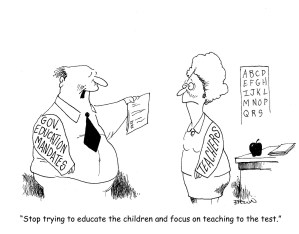
testing Joe Brown Stop EducatingIf you do more of what you’re doing, you’ll get more of what yo u got.

Those of you who love order and structure will most certainly find today’s post a bit troubling. You may recall that a while back now I began an exploration of Clark Aldrich’s three types of learning with some thoughts on “how to be”. You can find that post here.  [link]

That series got interrupted by my realization that there were a few big questions that preceded the exploration of Aldrich’s three kinds of learning and our need to respond to them. That “ah ha” resulted in an exploration of the first question  in the “where the hell are we and where are we going?” series, Cut the red wire…but first

Well now I’m going to interrupt the interruption… and return for a bit to the “how to be” exploration. To me it seems increasingly clearer that the process of learning how to be in today’s world is a growing challenge for our young people. They are regularly confronted with situations that have life-long implications for bad choices and they are grappling with these choices at a time when our schools have been under significant pressure to focus more on the academic accomplishments of their students than on the delivery intentional opportunities to explore in a safe environment who and how they will be in the world.

A recent newsletter prompted me to return to the “how to be” question and share some of the highlights from the author’s thinking and research. As a result of some work we did together some time ago, I receive regular newsletters from Dr. Howie Knoff, the director of Project Achieve, federally funded, evidence-based school improvement program focusing on positive behavior support and RTI programming.

In this issue of his bi-monthly newsletter, Dr. Knoff addresses the need for intentionality in helping students develop the kinds of skills that are associated with both academic and life success, frequently termed “soft skills.”

I urge you to read Dr. Knoff’s complete text[link to Dr. Knoff’s newsletter]. . It is an excellent source of material in support of the idea that we must begin to be intentional and deliberate about providing learning opportunities for our children that help them make positive decisions about who they are and how they wish to be in the world.

Dr. Knoff begins his article (italics mine)…

“. . . with all of the attention on the new Elementary and Secondary Education Act (or ESSA) and its focus on student engagement. . . or schools’ focus on disproportionality, trauma sensitivity, bullying, mindfulness, etc.–

We still need to recognize that:

If we do not teach students- – across their school-age years- – the interpersonal, social problem solving, conflict prevention and resolution, and emotional coping skills that they need to demonstrate. . .

 Why would we expect them to have them?”

He continues by offering what the majority of folks know to be true… that while the recent federal legislative efforts have highlighted the need for students to be college and career ready, the majority of focus has been driven by the decision to measure this readiness though the use of “a single, high stakes, standards-based test.”

Adding to the strength of his perspective and to the resources available to those of us who wish to move our schools and districts in this direction, Dr. Knoff shares recent research  here and here.

It highlights not only the personal benefits of participating in structured “soft skill” development programming, but also the academic gains demonstrated by those in such programs. He describes these skills as “Essential Skills” because they facilitate academic growth as well as the social-emotional dispositions and competencies necessary to function in the emerging team cultures of both post-secondary education and the work environment.

Of special note is that Dr. Knoff also terms these “Hard Skills” because our schools are not systematically and progressively offering such experiences to students, making the skills, competencies and dispositions harder to acquire for too many students.

In addition to the research that he shares, Dr. Knoff also offers what, to most, might be considered common sense connections between the “how to be” experiences and a more proactive response to persistent issues of student teasing, taunting, bullying, harassment, hazing, and physical aggression. He notes that “Without essential interpersonal, social problem-solving, conflict prevention and resolution skills, and emotional coping skills, these problems are unlikely to diminish.”

Beyond the rationale for the design and inclusion of intentional and progressive learning experiences for children beginning in the earliest grades and continuing throughout their school experience, Dr. Knoff also offers detailed descriptions of the targeted skills along with concrete suggestions/recommendations for implementation. For anyone who has found resonance with the idea that helping our kids learn how to be in the world they are experiencing, Dr. Knoff’s work has much to offer. I highly recommend it as both a jumping off point as well as a tool for structuring conversations within your learning community about the why, what, and how of this most critical part of Aldrich’s “types of learning” model.

And, as always, a few questions for you reflection and comment:

What would you write as a tweet in response to this piece?

How have you dealt with this in your school/classroom?

If you found resonance in these pieces on “how to be”, what might be your next action step?